Classical Greece · November, 333 BC
A Battle Under the Whole Sky
Alexander breaks the Persian king, and a German paints it from somewhere near the moon
look closer
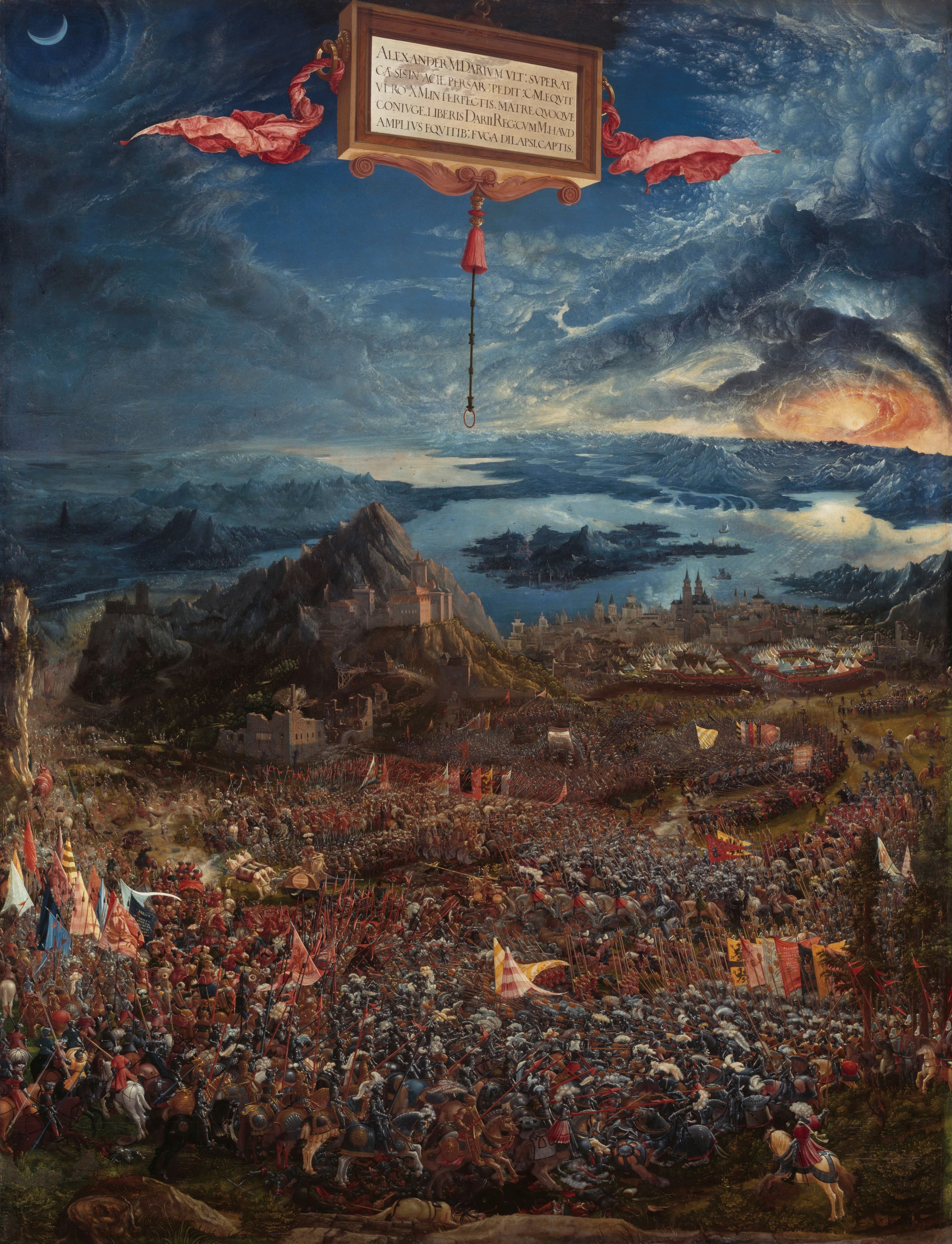
The sun drops into a spiral of cloud above a mountain range and a flat sheet of water. Altdorfer painted this in 1529, two centuries before a balloon lifted anyone high enough to look down at it.
The plain at Issus, on the coast of what is now southern Turkey, was too cramped for the Persians to use their numbers. Alexander caught the Persian king Darius III there in November 333 BC. Darius had swung in behind the Macedonians and cut their supply line, which felt clever until the armies met between the mountains and the sea and there was no room to spread. Alexander drove his cavalry straight at the king’s station in the center. Darius turned his chariot and ran, and the run became the rout of the whole army; his mother, wife, and children were taken in the baggage. It was the second of the three great battles that handed Alexander the largest empire the world had yet seen, and he was 23. The painting is the other half of the story, and it is stranger than the battle. Albrecht Altdorfer finished it in 1529 for Duke William IV of Bavaria, and he painted the field from an impossible height, as if the viewer hung in the sky. The armies below are thousands of small separate men, lances standing up like a wheat field. Above them the earth curves away past mountains and bays to a sun going down in a burning sky, a whole hemisphere in one frame. A Latin plaque hangs from the clouds on a cord, naming Alexander and counting the Persian dead. The year matters: as Altdorfer worked, the Ottoman army of Suleiman was marching up the Danube, and in the autumn of 1529 it laid siege to Vienna. His ancient Persians wear sixteenth-century Turkish turbans. He was painting the news. The geography is a map more than a memory. The water winding into the distance is meant for the eastern Mediterranean, the Nile mouths, Cyprus and the Red Sea. It is the shape of the known world seen from above, two centuries before anyone could rise to look. Altdorfer ran the city of Regensburg as a councilman and turned down the office of mayor to keep painting. This is the picture he wanted the time for. It found one more famous admirer. When Napoleon’s men stripped the Bavarian collections around 1800, he kept this one for himself. Prussian troops took the château of Saint-Cloud in 1814 and found the Battle of Issus hanging in the emperor’s bathroom. He too thought he was Alexander. The picture went back to Munich in 1815, where it hangs now, still showing a battle seen from a window in the sky.