Classical Greece · c. 336 BC
The Lamp at Noon
A philosopher lives in a jar, lights a lamp in daylight, and tells a king to move
look closer
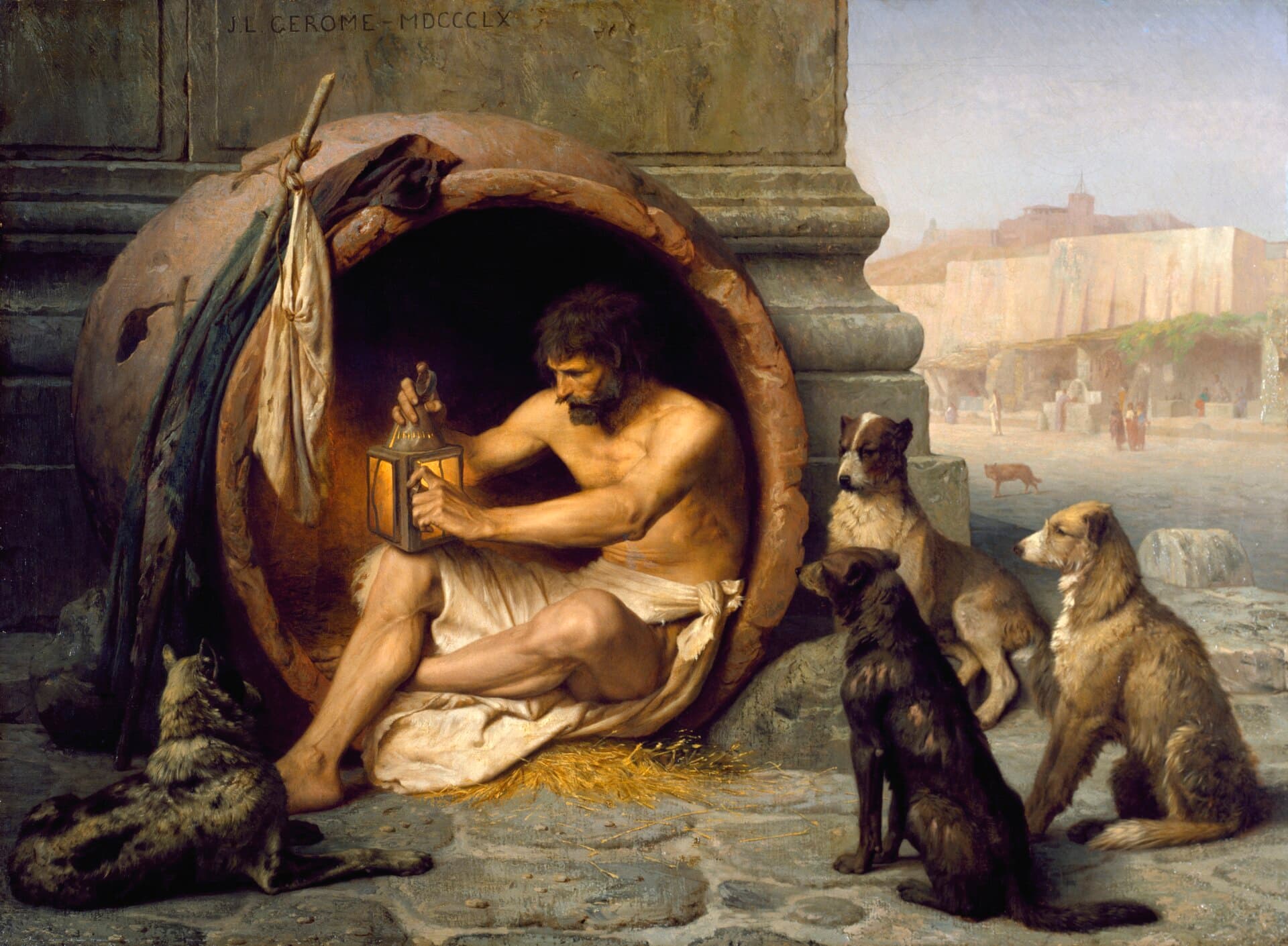
Diogenes reaches into the lantern with the flame already burning inside it. He carried it through the market in broad daylight and told anyone who asked that he was looking for a human being.
Diogenes of Sinope lit a lamp in broad daylight, carried it through the crowded market, and told anyone who asked that he was looking for a human being. He did not find many. He had come to Greece as an exile. Back in Sinope, on the Black Sea, he or his father had been in charge of the coinage and had defaced it, struck the metal out of true. He took the phrase for that, deface the currency, as his life’s program: he would knock every false custom out of true the same way. He owned a cloak, a stick, and a bag, slept in a large storage jar, a pithos, and threw away his one wooden bowl when he saw a boy drinking from cupped hands. He made rudeness into a philosophy. He ate and did worse in the marketplace on principle, arguing that nothing natural could be shameful. He called himself a dog, and the school that grew from him got the name Cynic, from kynikos, doglike. When Plato defined a human being as a featherless biped and won applause, Diogenes plucked a chicken and threw it over the wall of the Academy: here is Plato’s man. Asked where he came from, he is supposed to have said he was a citizen of the world, which was a new idea and his coinage too. The famous meeting came at Corinth, most likely in 336 BC, when the Greek states gathered to make the young Alexander their war leader against Persia and the whole political class came to flatter him. Alexander went to find the philosopher instead, and found him lying in the sun. He offered to grant anything Diogenes wanted. Stand a little out of my sun, Diogenes said, that is all. Plutarch says the courtiers laughed, and that Alexander, riding off, told them that if he were not Alexander he would want to be Diogenes. They are said to have died on the same day, in 323, Alexander of fever in Babylon and Diogenes at Corinth in old age. The cause was a held breath, or a dog bite, or a raw octopus. The stories vary, and he would have preferred that they did. Jean-Léon Gérôme painted him here in 1860, in the jar, working on the lamp, ringed by stray dogs. Behind him the citadel of Corinth stands up out of the haze. Gérôme signed it as though the letters were cut into the stone wall above the jar: J.L. GEROME MDCCCLX.