Classical Greece · June, 323 BC
To the Strongest
The king burns with fever in Babylon while the diary keeps the hours and the army files past
look closer
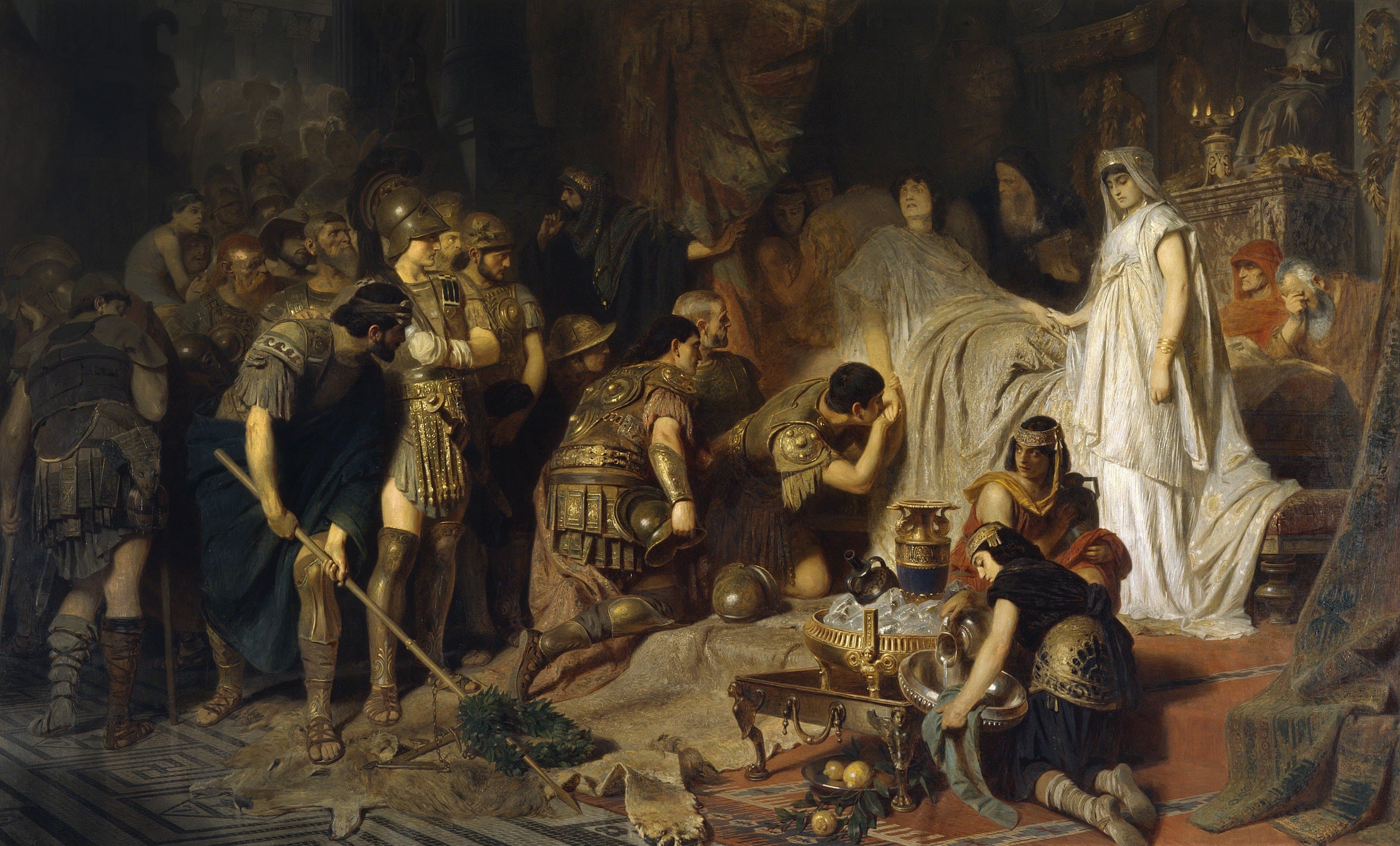
Alexander is propped on the couch with his eyes open and no voice left. A veiled woman stands over him with her hand on the covers. The court day-book logged the last days flatly: bathed, sacrificed, played dice, worse each night.
In late May of 323 BC, in the palace at Babylon, Alexander drank late at a friend’s party, and a few days later the fever started. He was 32 and had not lost a battle. The court kept a day-book, the Royal Diaries, and its entries on the illness survive at second hand through later writers. They read like a chart: the king bathed, sacrificed, ate a little, lay in the bathhouse because it was cooler, played dice, listened to his officers. Each day the fever was worse and he said less. Doctors could do nothing. Toward the end he could not speak at all. The army would not accept a rumor. Thousands of Macedonian soldiers pressed at the palace demanding to see him alive. Rather than turn them away, his officers opened the doors and let the whole army file through the bedroom, one man at a time. He could no longer talk. Arrian says he greeted each of them with his eyes, or by lifting his head a little, as they passed the bed in silence. When they asked who should have the empire, the surviving accounts give the answer as to the strongest. The Greek for that sounds much like the name of Krateros, one of his generals, who was not in the room. He may have been naming a man rather than starting a civil war. He may also have been too weak to say anything at all, and the line was supplied for him later. He died on 11 June, in the late afternoon. Modern scholars fixed the date from Babylonian astronomical tablets that log the same days. There was no strongest, so there were the wars of the strongest, 40 years of his generals carving the world up between them. The body became a prize in that fight. A grand funeral cart was built to carry him back toward Macedonia. On the road Ptolemy, who had taken Egypt, seized the procession and turned the body south to Memphis, and later to Alexandria. He kept the dead king as the seal on his claim. His tomb was a tourist site for centuries, visited by Roman emperors, and then it was lost, and it is lost still. The deathbed here is Karl von Piloty’s. He died in 1886 with it still unfinished, the last of a long line of big history canvases he built like stage sets. Alexander lies white under white cloth. The officers crowd in with their armor and their grief, and a veiled woman stands over him with her hand on the covers. On the floor near the front a young soldier kneels among helmets and an overturned wine jar and does not look up. The room is already dividing the estate.