The Machine Age · 15 April 1912
The Unsinkable
The largest machine ever built spends 2 hours and 40 minutes sinking
look closer
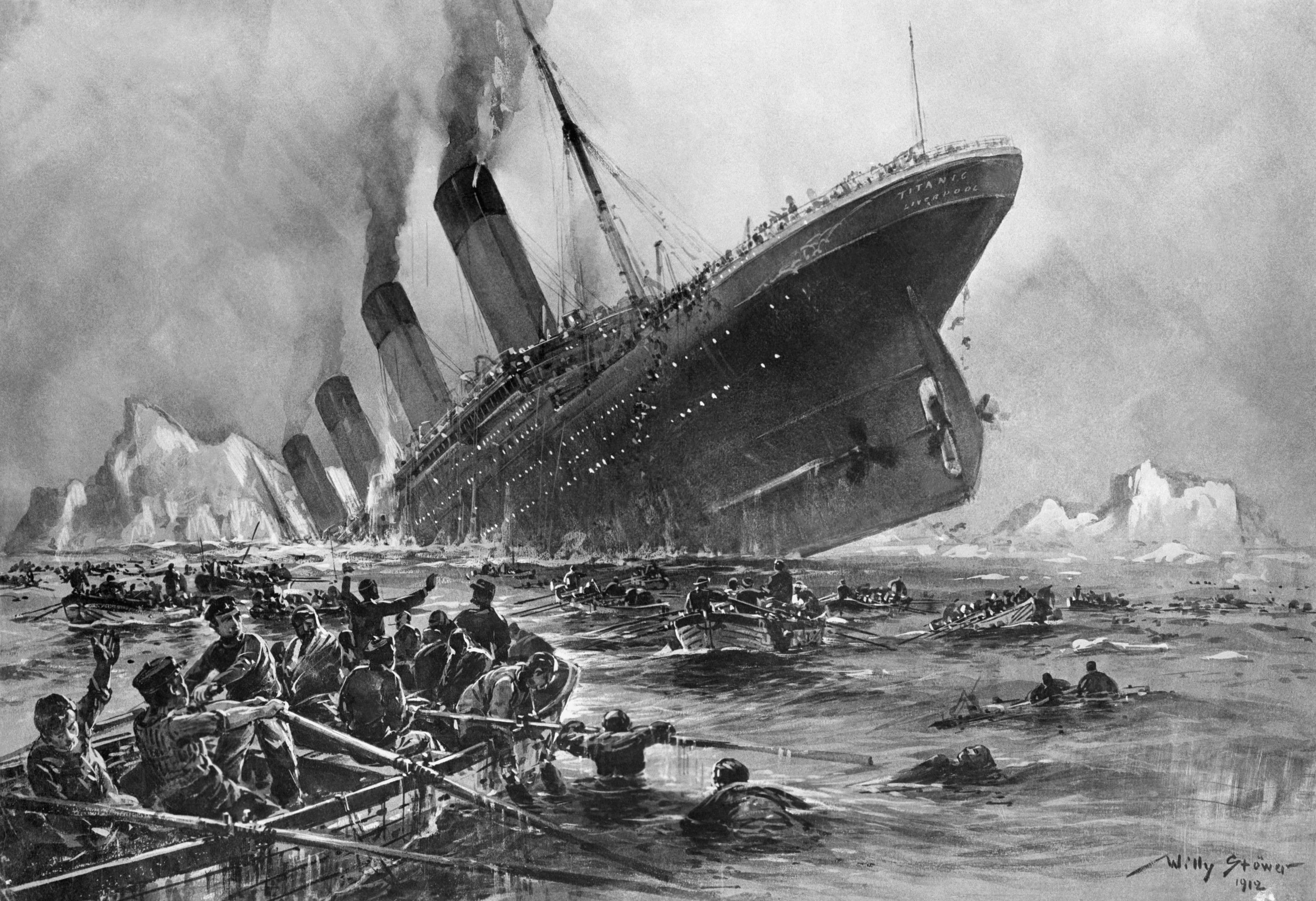
The stern is up far enough to show the rudder and a propeller blade, and small figures are sliding down the plating. Under the name Stöwer painted the port she was registered in, Liverpool. Titanic never entered that city.
The regulations were written for a ship a fifth her size. British law set lifeboats by tonnage and the table stopped at 10,000 tons; Titanic was registered at over 46,000. Her 20 boats held seats for 1,178 of the 2,224 people aboard, and that was not a scandal, it was compliance. The trade press had called the class practically unsinkable, and the qualifier wore off in conversation. She was the largest moving object human beings had ever made, four days into her first crossing, running at better than 22 knots through a calm, moonless, iceberg-reporting sea. At 11:40 on the night of the fourteenth of April the lookouts, working without binoculars, which were locked in a cabinet whose key had left the ship at Southampton, saw the berg dead ahead. The helm went over; the ice opened 300 feet of seams below the waterline along six compartments. The ship could float with four flooded. Her builder, aboard for the maiden voyage, did the arithmetic in minutes and gave her one to two hours. She took two hours and forty. In that time the band played on deck, and the wireless men sent the new SOS alongside the old CQD. The boats went down half-empty at first, 28 people in a boat built for 65. The drop looked worse than the deck, and no one had drilled the loading. Ten miles off, the steamer Californian sat stopped in the ice with her wireless operator asleep, watching white rockets she could not interpret. The Carpathia, four hours away, ran her boilers ragged and arrived at dawn to find boats, wreckage, and 710 survivors. The water was two degrees below freezing; nearly everyone it took, it took in minutes. First-class women survived at over 90 percent. Third-class women, below half. The night's conduct sorted people faster than any regulation. Ida Straus, whose husband co-owned Macy's, was handed toward a boat and stepped back out of it, saying she would not leave him after four decades; witnesses put them last seen seated together on deck. The two young Marconi operators stayed at the key, selling their position to every ship in range until the power died under them; one lived, one did not. The band's leader, Wallace Hartley, was recovered days later with his music case still strapped to his body, and whether the last tune was the hymn the legend insists on, no two survivors quite agreed. The Californian's captain spent the rest of his life explaining the rockets his watch had seen, logged, and not woken him for. No photograph exists of the sinking, which is why the world remembers it through a drawing made in Berlin. Willy Stöwer, the Kaiser's favorite marine painter, produced the scene for the illustrated press within days: stern rising, funnels leaning, boats pulling away over crowded water, icebergs standing in on both sides. He worked from cables and imagination, and he made mistakes the ocean kept secret for decades. His hull goes down whole. When the wreck was finally found in 1985, two and a half miles down, she lay in two pieces. It did not matter. His guess had already become the memory. The corrections came fast and stayed: lifeboats for all, boat drills, a patrol that still counts icebergs, wireless watched around the clock at sea. The age's faith in its machines was harder to repair. Stöwer signed the drawing in the corner, over water he never saw.