Classical Greece · c. 600 BC
The Tenth Muse
Nine books rot down to one whole poem and an Egyptian rubbish dump keeps the scraps
look closer
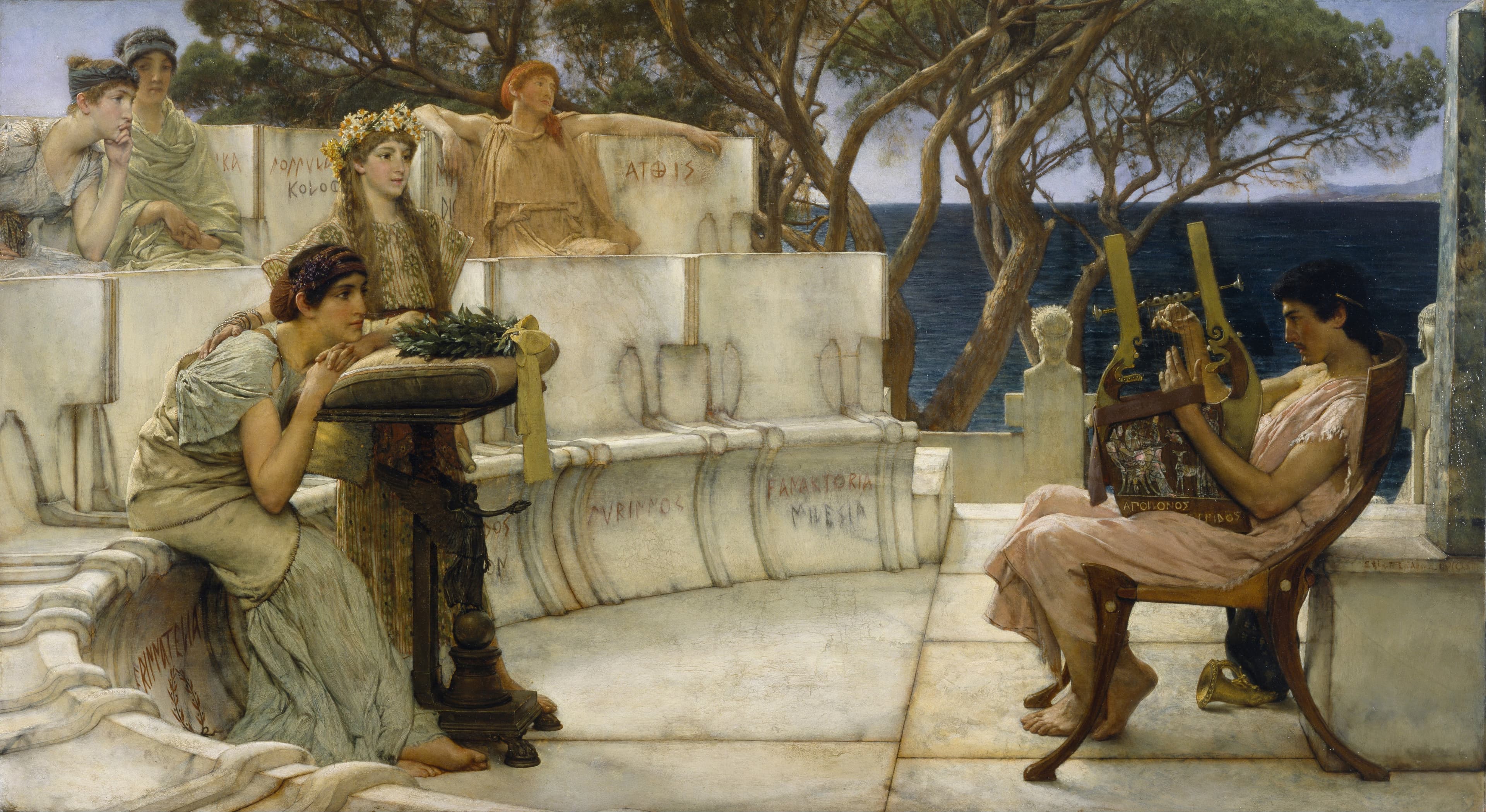
Sappho leans on the cushioned lectern with her chin on her hands. The laurel wreath is laid down by her elbow. No likeness of her survives from her own century, so this face is invention like every other face of her.
A stone chronicle called the Parian Marble, cut more than two centuries after her death, records that Sappho sailed from Mytilene into Sicilian exile. That entry is about as solid as her biography gets: a place, Lesbos; a trade, songs for the lyre; a working date around 600 BC. Herodotus fills in a brother, Charaxos, who shipped Lesbian wine to Egypt and spent a fortune there freeing a famous courtesan, and says Sappho scolded him for it in a poem. She mentions a daughter, or a girl she loved as one, Kleis, her form, she says, like golden flowers. The rest is fog, and verse. About the scale of the verse antiquity had no doubts at all. The scholars of Alexandria collected her into nine books, the first of them more than a thousand lines long. Aristotle notes that the Mytileneans honored Sappho although she was a woman. An epigram handed down under Plato’s name redoes the arithmetic: some say there are nine Muses, but look again, Sappho of Lesbos is the tenth. Mytilene stamped her head on its coins. And Aelian tells of Solon of Athens hearing one of her songs over the wine and demanding to be taught it at once, so that he could learn it and die. Then the books rotted. A late legend blames church bonfires; the duller mechanism is that papyrus decays wherever the climate is not desert, and her Aeolic dialect went obscure early, so the copying stopped. One poem survives whole, a prayer to Aphrodite, and only because the critic Dionysius of Halicarnassus pasted it entire into an essay on style. Nearly everything else is scrap. The biggest sack of scraps was the town dump of Oxyrhynchus in Egypt. Two Oxford men started digging there in 1897 and hauled out ancient rubbish by the basket: tax receipts, contracts, and strips of her. In 2004, papyrus recycled as mummy casing gave back most of a poem about going grey. In 2014 another piece surfaced from a private collection, with an ownership history nobody could quite explain. In it she worries about Charaxos and his ships: the same brother, 25 centuries after Herodotus passed along the family gossip. Alma-Tadema painted her in 1881, listening. The man at the kithara is Alcaeus, Mytilene’s other great poet, whose surviving lines call her violet-haired, holy, honey-smiling. A Hellenistic poet, Hermesianax, insisted the two were in love, and that romance is the picture’s plot. The marble is more honest than the plot. Alma-Tadema copied the tiered seats from the Theater of Dionysus in Athens, then replaced the carved names of Athenian officials with girls out of Sappho’s poems. Two of them are still legible in red along the tiers: Gyrinno, and Anactoria of Miletus.