Classical Greece · c. 650 BC
A Fox Under the Cloak
Sparta takes its boys at 7 and sends its girls to the running ground
look closer
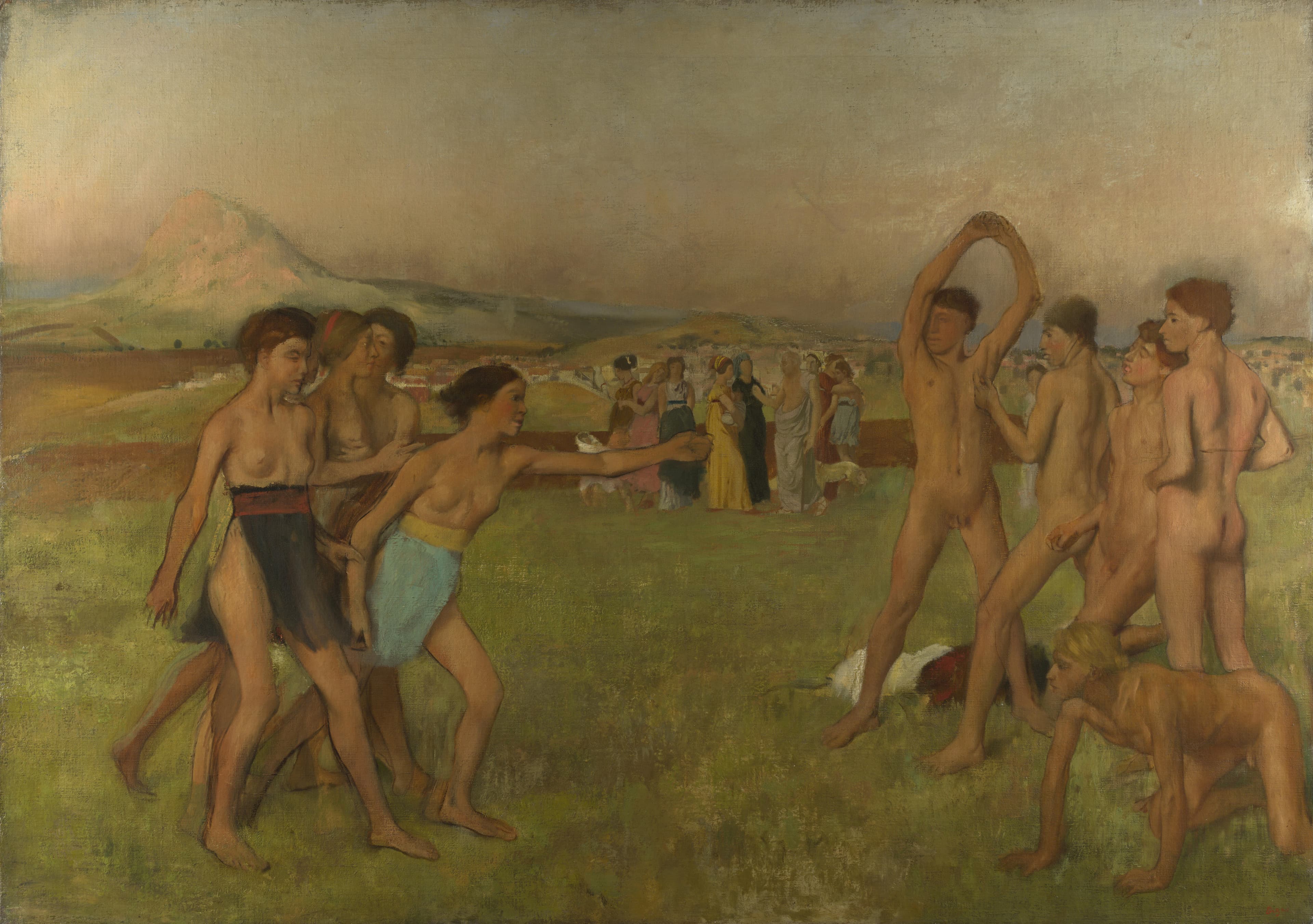
The girl in the blue skirt leans out over the grass with her arm level and calls the boys across. Plutarch says Spartan girls ran, wrestled and threw the javelin. They also sang public mockery of any boy who trained badly.
The year a Spartan boy turned 7, the city came and took him. Plutarch lays the system out in his life of Lycurgus. The boys went into herds, that is the actual word, agelai, under a 20-year-old captain called the eiren, who held the whip. They learned reading, Plutarch says, only as much as they needed. Everything else was one long training in obedience and hunger. At 12 a boy got one cloak a year and no tunic, and slept on rushes he pulled by hand from the banks of the Eurotas, no knife allowed. Rations were cut thin on purpose. A hungry boy steals, and stealing was the curriculum; it taught patience and nerve. The whip was for getting caught, never for the theft. Plutarch then tells the story every Spartan child was raised on. A boy had stolen a fox cub and hidden it under his cloak. When the owners came searching he stood and let them question him while the animal tore through his belly with claws and teeth. He dropped dead rather than be found out. Plutarch adds that he finds this believable, because in his own day he watched Spartan boys die under the lash at the altar of Artemis Orthia sooner than cry out. The girls were never sent to the herds, and what happened instead scandalized every other city in Greece. Lycurgus, Plutarch says, had them run, wrestle, and throw the discus and the javelin in the open air, so that children would grow strong in strong bodies. He also taught them songs of praise for the boys who trained well, and public mockery for the ones who shirked. Elsewhere in Greece a daughter stayed indoors at the loom. In Euripides an old man sneers that a Spartan girl could not be modest if she tried, out of the house with bare thighs and loosened dress, sharing the running grounds with young men. The rest of Greece coined a nickname, phainomerides, the thigh-showers. Sparta heard it as a compliment. This was the Sparta of the long second war with Messenia, the war Tyrtaeus wrote marching songs for, and the machine had exactly two products: soldiers, and the mothers of soldiers. Degas painted the confrontation around 1860, before he turned 30, and then could not leave it alone. Over the following 20 years he scraped away the classical profiles and gave the children the faces of Paris street kids, the gamins of Montmartre, as his cataloguer André Lemoisne put it. The canvas stayed in his studio, unfinished, until he died in 1917. X-rays show how restlessly he moved the bodies around: the four girls of the front rank have ten legs among them. And behind the whole contest, small and pale above the town, he set Taygetus, the mountain where Plutarch says the elders of Sparta left the newborns who failed inspection.