Ancient Egypt · Autumn, 48 BC
The Smuggled Queen
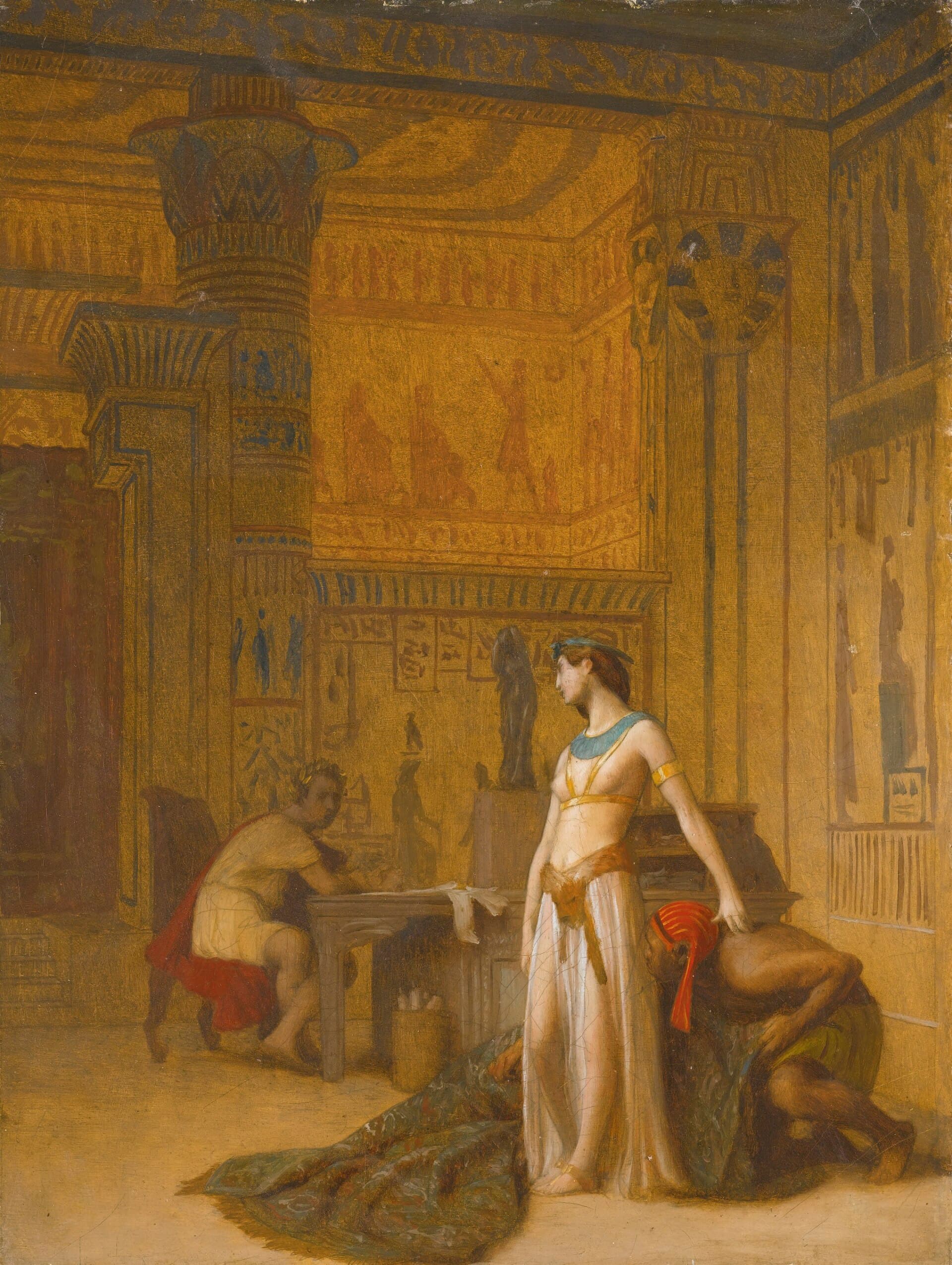
Smuggled past her brother’s sentries, a deposed queen is unrolled at Caesar’s feet
look closer
Gérôme put a broad Egyptian collar on his Cleopatra and stood her against walls copied from temples a thousand years too old for her palace. Her own court was Greek and had been for two and a half centuries.
The head arrived first. Caesar landed at Alexandria in October of 48 BC, chasing the beaten Pompey with a fraction of an army. The boy king’s ministers sent him Pompey’s severed head and signet ring, expecting gratitude. Plutarch says Caesar turned away from the head and wept over the ring. He then moved into the royal palace and did not leave, which was the first sign that the ministers had misjudged their man. The second was that he began issuing rulings about the throne, and summoned the feuding heirs of the dead Ptolemy XII. One was the boy, Ptolemy XIII, run by the eunuch Pothinus. The other was his sister Cleopatra, 21, driven from the capital and camped with hired soldiers out past the eastern marshes. Her problem was simple. Her brother’s army held the roads, the harbor watched for her face, and a recognized queen would not have lived to reach the palace gate. So at dusk she came in a small boat with a single companion, a Sicilian named Apollodorus, landed below the palace wall, and climbed into a bedding sack. Apollodorus tied it shut with a strap, carried it through the gates as luggage, and set it down in front of Caesar before untying the knot. Plutarch, who tells it, says this piece of nerve was the first thing about her that captured him. Caesar ruled for her claim within days, which is why the war began within weeks. It nearly killed him. Pothinus called the royal army in from the frontier, 20,000 men against Caesar’s 4,000, and the fighting ran street by street all winter. Caesar burned the Egyptian fleet at its moorings rather than let it close the harbor. In the fight for the great causeway his own ship went down and he swam for it, holding his papers out of the water with one hand, Plutarch says. His general’s cloak went overboard, and the Egyptians fished it out and hung it up as a trophy. Relief came overland in the spring, the royal army broke at the Nile, and the boy king drowned in the river; Florus says they knew the body by its gilded corselet. Caesar had stayed nine months by the time he sailed east, after a long cruise up the Nile with the queen he had restored. Their son was born that June, and Alexandria coined the nickname that stuck: Caesarion, little Caesar. Gérôme painted the unpacking in 1866 and rolled the queen in a Persian carpet, which is where the world’s favorite version comes from; Plutarch’s word means a sack for bedclothes, tied with a strap. The room is dressed wrong too, and knowingly. Gérôme copied his walls from monuments a thousand years older than the palace he was painting. That palace was Greek to the rafters, marble and gilt in a city where the court spoke nothing else. His Cleopatra stands barefoot on the spilled carpet, already giving orders with her eyes. The sack, the strap and the Sicilian are all Plutarch; the carpet is Paris, 1866.