Ancient Egypt · Winter, 332 BC
A City Drawn in Barley
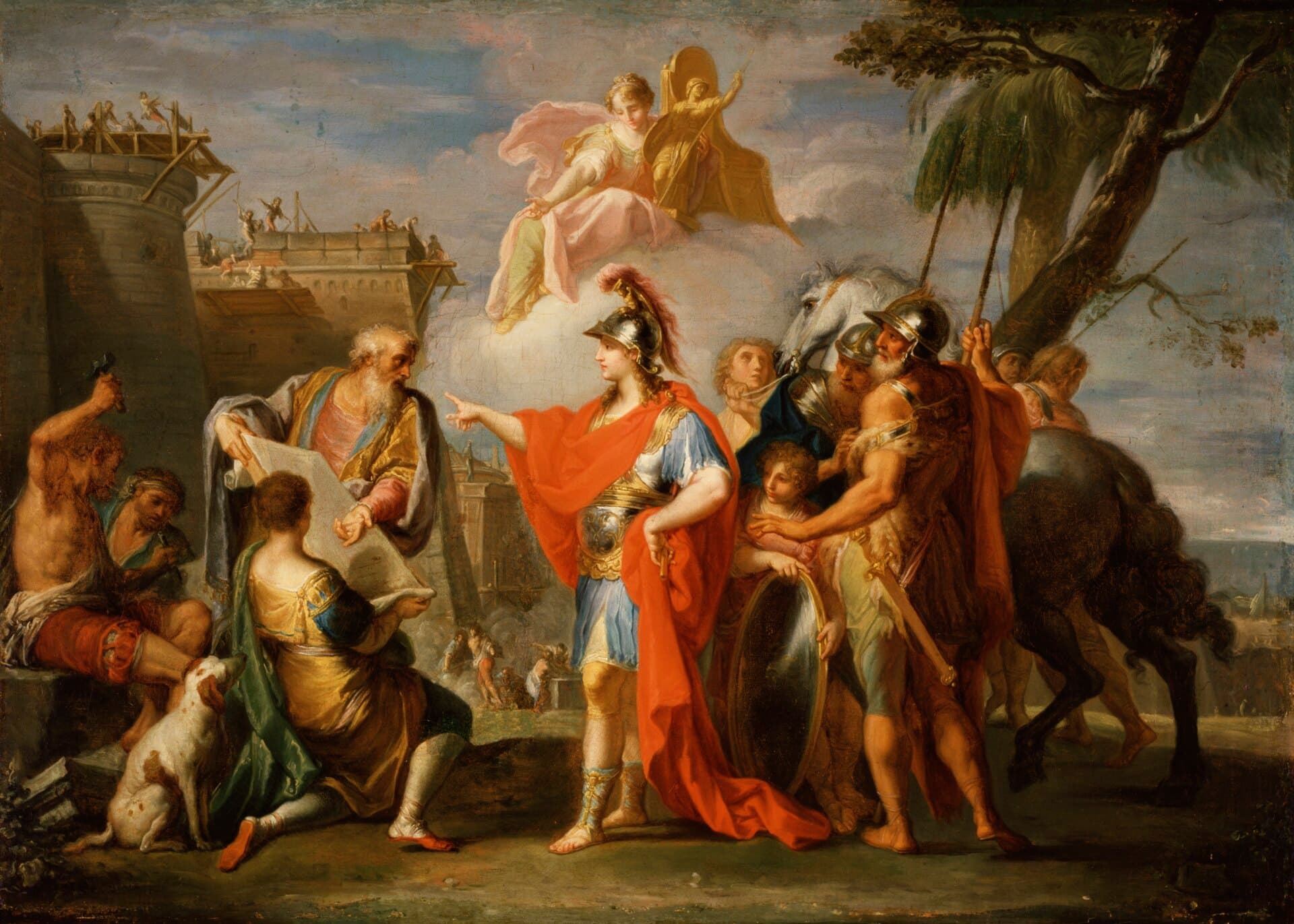
Out of chalk, Alexander’s surveyors mark the streets of his new city in barley meal
look closer
A man holds the plan open at Alexander’s pointing hand, and a kneeling woman steadies the other edge. The man is the architect Deinocrates of Rhodes. Vitruvius says he first caught Alexander’s eye by offering to carve Mount Athos into a seated statue of the king, with a walled city in its palm.
Egypt did not fight him. Alexander came down from Gaza in the autumn of 332 BC, 24 years old and unbeaten. The Persian governor Mazaces had no army worth the name and handed over the country and its treasury. Persia had taken Egypt back only 11 years earlier, and was hated for it. At Memphis the Macedonian did what a pharaoh does. He sacrificed to the Apis bull, the living animal of the god Ptah, and the scribes began enclosing his name in a royal cartouche. Persian kings had earned three generations of loathing by insulting exactly this; Alexander, who mocked nothing useful, bowed to the bull and gave games for the priests. Sailing down the western arm of the Nile that winter, he found what he was actually after: a limestone ridge between the sea and a lake. It lay opposite the island of Pharos, which Homer had put in the Odyssey. Plutarch says a white-haired old man recited those very lines to Alexander in a dream, and that he went to look on the strength of it. The harbor needed no dream: deep water, an island for a breakwater, a lake behind for river traffic. He paced the ground himself, market here, temples there, walls in a great arc, and when the surveyors ran out of chalk they marked the street lines with barley meal from the soldiers’ ration bags. Birds came down in clouds and ate the plan. The seers, thinking fast, read it as a promise that the city would feed men of every nation. The architect who drew it up properly was Deinocrates of Rhodes. Vitruvius says he had introduced himself by offering to carve the whole of Mount Athos into a seated statue of Alexander, with a walled city in its palm. Alexander had asked what that city would eat, heard nothing good, declined the mountain and kept the architect. From the unbuilt streets he marched west along the coast and then inland, some 300 miles, to the oracle of Ammon at the Siwa oasis, through desert said to have swallowed a Persian army whole. Rain fell for his column. Ptolemy, who was there and became a king with a memoir, swore two talking snakes led the way; other veterans remembered crows. At the temple the old priest greeted him as son of the god, and Plutarch adds the earthbound version: the priest’s Greek slipped, and my son, paidion, came out pai Dios, son of Zeus. Alexander put his questions to the oracle alone and wrote to his mother that he would tell her the answers in person. He never saw her again, and he never saw a street of his city built. He left Egypt in the spring of 331. Two years after his death in Babylon his body came back: Ptolemy hijacked the funeral cart on its road to Macedon and kept the founder as the new capital’s founding relic. Placido Costanzi, a Roman, painted the founding around 1737 as pure theater: Alexander in parade armor points at the plan while Deinocrates holds it open, and masons are already up on the scaffolding behind them. The canvas hangs in Baltimore now. The round bastion tower going up behind the surveyors belongs to Costanzi’s century, not Alexander’s, and over it all a woman leans out of a cloud with a gilded armed figure at her shoulder.