The Renaissance · 1586
The Painter of Lightning
Toledo commissions a miracle and gets weather from another world
look closer
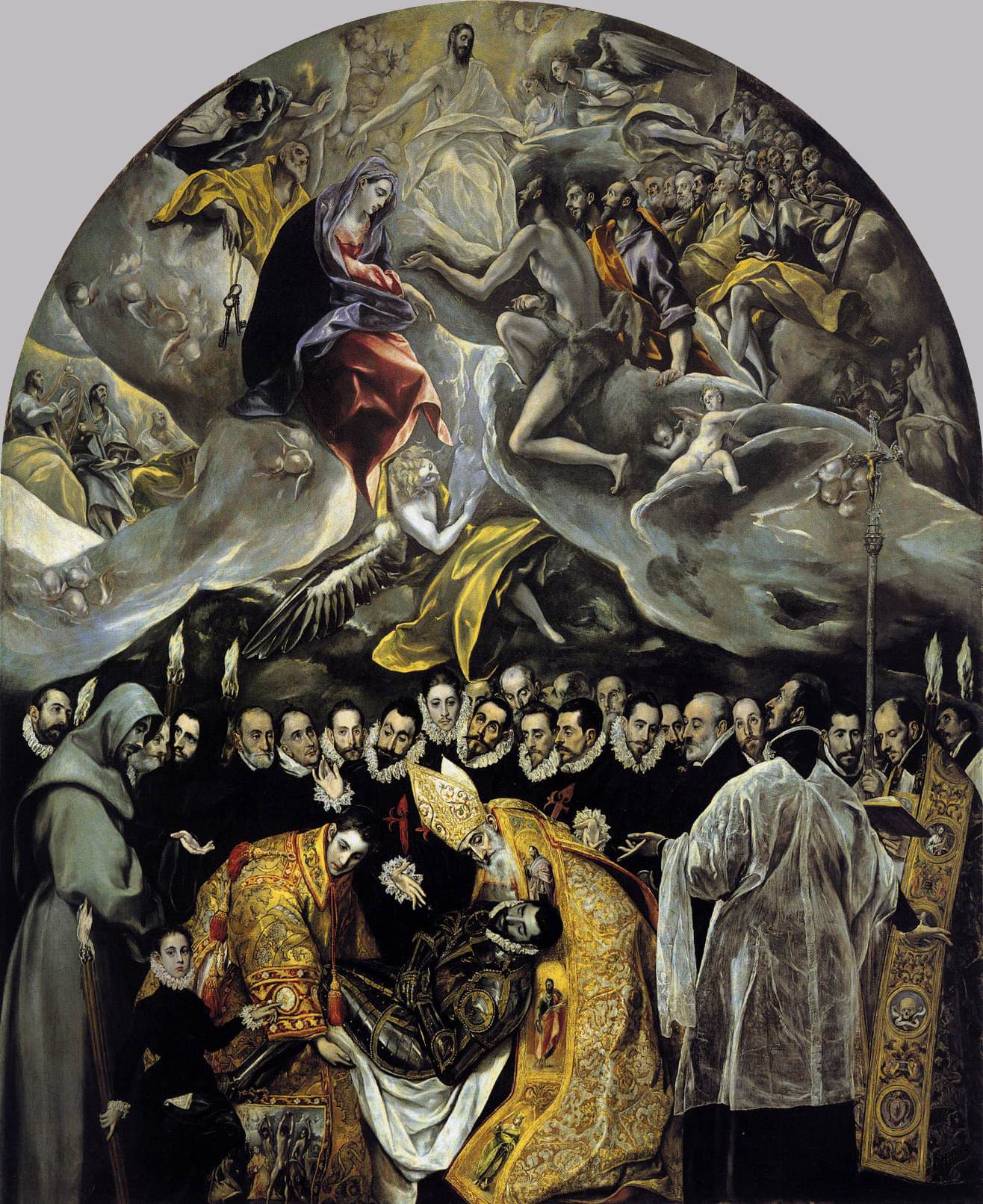
Saint Augustine and Saint Stephen stoop over the body, one in a tall bishop's hat and one in a gold robe. The count's black armor picks up the yellow and red of both. Tiny painted saints stand in the woven gold of the robe, pictures inside the picture.
The commission was two and a half centuries late. The legend ran like this. In 1323 the pious Don Gonzalo Ruiz, lord of Orgaz, was being buried in the little Toledo church of Santo Tomé. Saints Stephen and Augustine came down in person and laid him in the grave with their own hands. The town of Orgaz owed the church an annual payment from the dead man's will, and had stopped paying it. In 1569 the parish priest, Andrés Núñez de Madrid, won the lawsuit that forced the back payments. He spent the winnings 17 years later on a painting of the miracle, and hired the strangest painter in Spain. Doménikos Theotokópoulos had come a long way to be available in Toledo. A Cretan, he trained to paint icons in the flat gold manner of Byzantium. In Venice he remade himself on Titian's color. In Rome he reportedly offered to repaint Michelangelo's Last Judgment if they would tear it down, which made his stay there short. Then he followed the money to Spain, where King Philip II took one look at his altarpiece and declined further orders. Toledo, proud, priest-ridden and past its peak, took him in. Spain never managed his name and settled for El Greco, the Greek. What he delivered fills a wall of the church. The lower half is Toledo itself: a row of living gentlemen in black and white ruffs, portraits every one. They attend a funeral from 1323 with unhurried sixteenth-century faces. The two saints, in embroidered vestments, stoop under the weight of the count in his polished armor. There is no ground, no horizon, no sky, only faces and steel and cloth. Above them, the sky El Greco left out of the earthly half happens all at once. Cloud is torn open like surf, and saints stream toward a small distant Christ. In the middle an angel pushes the count's soul up through the narrow gap. The soul is painted as a faint cloud in the shape of an infant, and heaven receives him the way the world delivered him. The two halves do not share a single rule of space, and that is the sermon. The parish got more than it contracted for and paid accordingly, in the end. The agreement had specified the essentials, the saints, the mourners, the heaven above, and when two appraisers valued the finished work at 1,200 ducats the parish balked. The Escorial had paid 800 for his Saint Maurice, the cathedral 318 for the Espolio. El Greco fought valuations his whole Spanish career on the principle that his art had no market price; this time the archbishop's council heard the argument out and ordered the parish to pay in full. The dead man himself is nearer than most visitors realize. Don Gonzalo's remains lie in the wall directly beneath the canvas, so the painted burial hovers over the actual one. The stone below the frame finishes the picture's sentence in Latin. He signed it where only a careful visitor finds it. The signature sits on the handkerchief of the solemn boy at the front who points into the picture, his son Jorge Manuel. Beside it he wrote not the painting's date but 1578, the year the boy was born. The painting has never left the church. Toledo's gentry aged and died; the row of ruffs stayed. Three centuries later, painters hunting a way out of the academy, Cézanne and then the young Picasso among them, decided the mad Greek had arrived early rather than wrong. The mourners stand where the visitor stands. Anyone who walks in completes the row.