The Renaissance · c. 1486
The Goddess Returns
A banker hangs a naked goddess in his villa and calls it philosophy
look closer
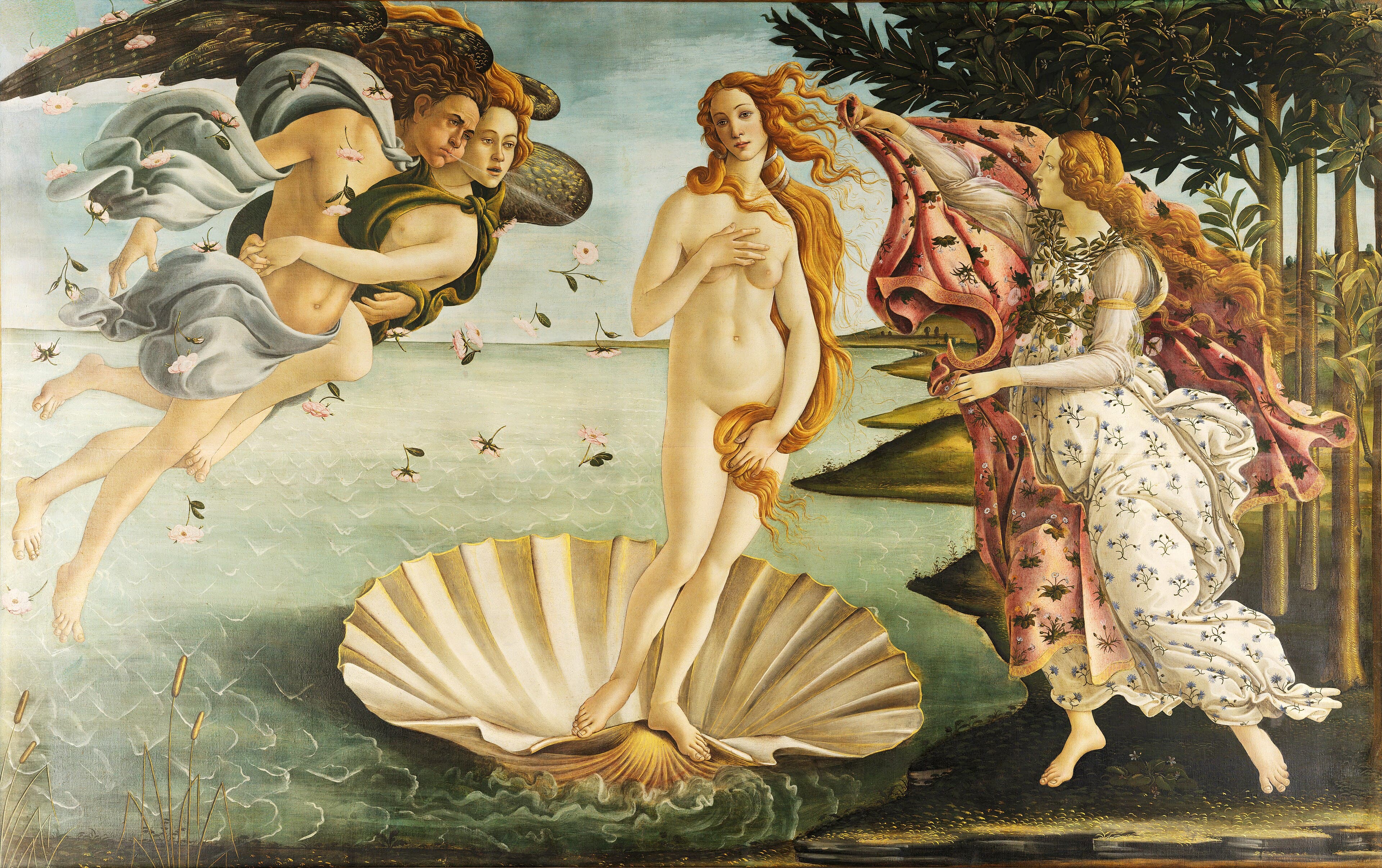
The wind spirit Zephyr and the woman locked around him are both blowing, hard enough that the roses travel on the breath. Every flower has a stroke of gold at its center. The wings above them are drawn over in fine gold lines.
The picture was made for a country house. Around 1486 a young cousin of Lorenzo the Magnificent wanted something for a Medici villa outside Florence. Botticelli painted him a goddess arriving: Venus born full-grown from the sea, blown to shore on a shell by two entwined wind spirits. Spring herself runs up the beach with a flowered cloak, one second too late. He painted it in tempera on canvas, the cheaper support used for pictures that would hang in the country, which is one reason the most famous painting in Florence spent its first centuries as furniture. Nothing like it had been made for a thousand years. A life-size female nude, no saint, no Eve, no excuse of scripture: the last time Europe painted such a thing, the empire was Roman. Botticelli borrowed the pose openly from an ancient marble Venus of the type the Medici owned: one arm across the breast, weight on one leg. The scene came from the old poets by way of his friend Poliziano, the house scholar, whose verses describe exactly this arrival. The philosophy was the alibi and half the point. In the circle around Marsilio Ficino, who was busy fusing Plato with Christianity, Venus stood for divine love made visible; contemplating her beauty was supposed to pull the soul upward. A naked goddess on the wall of a banker's villa, in other words, came certified as an instrument of virtue. She has a sister in the same house. The Primavera, painted a few years earlier for the same family circle, kept her company for generations. When the historian Vasari finally recorded the two paintings in the 1550s, he found them together at the Castello villa, already old furniture to their owners. The pair share a cast and a gardener's inventory: botanists have counted scores of identifiable plant species in the Primavera's meadow, painted petal by petal by a man trained in a goldsmith's shop. Venus got the opposite treatment, a sea of almost nothing, chevron waves like shorthand, so that every ounce of the picture's weight lands on the figure. Botticelli could do abundance or emptiness at will. He spent his whole account of both on the same goddess. Florence added its own legend: that the face belongs to Simonetta Vespucci, the married beauty the whole city had adored, dead of consumption at 22 a full decade before the painting. There is no document for it, only the city's wish that its two most beautiful things be the same thing. What is certain is the gold, threaded stroke by stroke through the hair and the wings and the little roses that fall with the wind, each flower dropping since 1486 and never landing. The painting also survived its own era's regret. In 1497 the friar Savonarola ruled Florence's conscience, and his followers burned the vanities of the city in the public square: mirrors, dice, pagan pictures. Botticelli himself, old and increasingly devout, is said to have put works of his own on the fire. Venus was miles away in the country, and missed the reckoning. The friar himself went to the fire the next year, hanged and burned in the same square where the vanities had burned, before a crowd that had jeered for him and now jeered at him. She waited out three centuries in Medici storage and villa corridors until the nineteenth century decided she was the very face of the Renaissance. The Pre-Raphaelites made pilgrimages, Ruskin lectured, and the tempera goddess became the poster of a rebirth she had slept through. The wind spirits are still mid-breath. Spring still has not managed to get the cloak on her.