The Machine Age · 15 April 1874
The Insult That Named a Movement
Rejected by the Salon, 30 painters open their own show; one hazy harbor names them
look closer
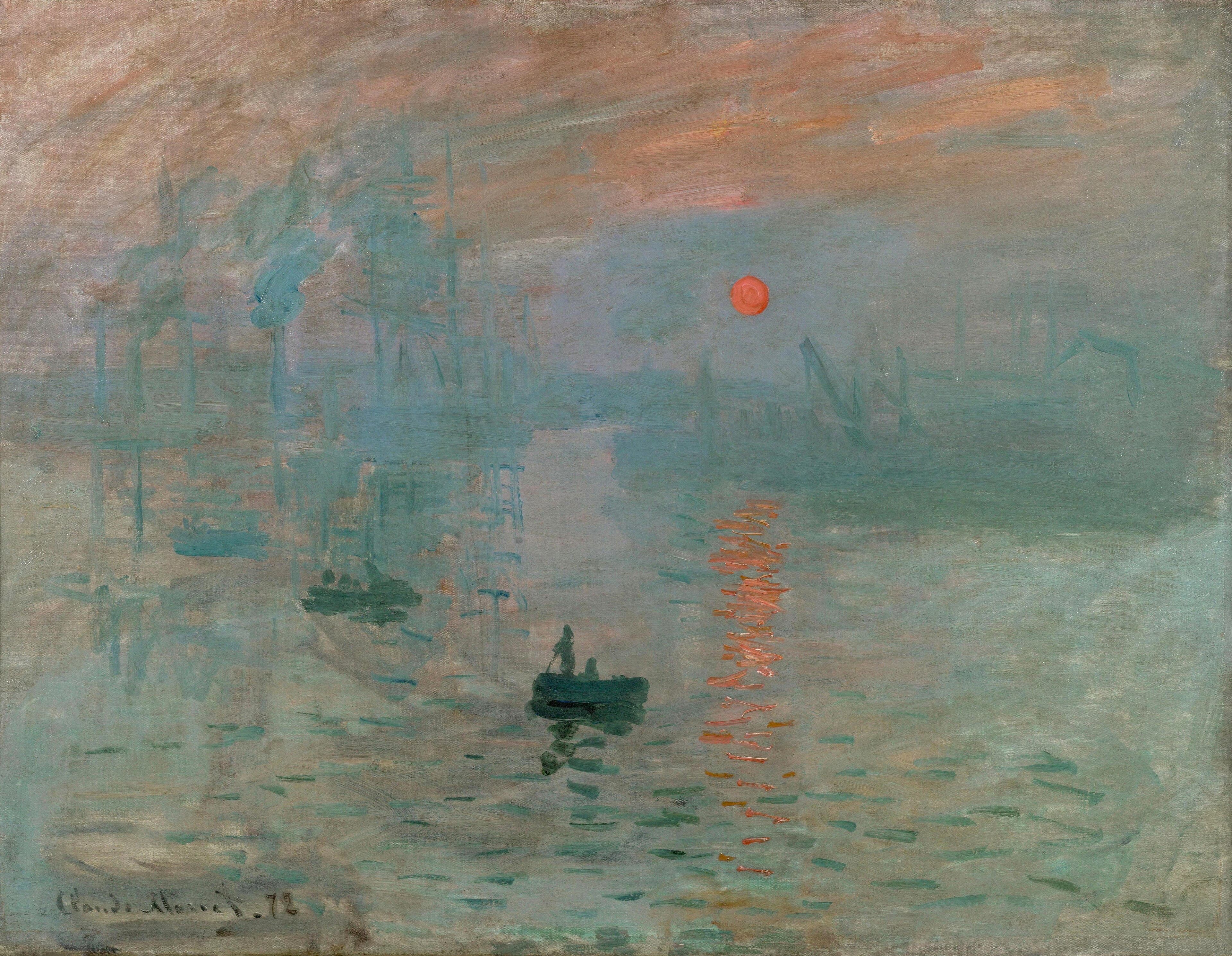
The sun seems to pulse because Monet painted it at nearly the same brightness as the sky. The eye picks up the color but not the edge. In black and white it almost vanishes.
The address matters: 35 boulevard des Capucines, the photographer Nadar's old studio, red-walled rooms up a staircase in the middle of commercial Paris. On the fifteenth of April, 1874, about 30 painters open their own exhibition there, an act of trade rebellion more than of art theory. In their France, one show counts: the official Salon, one jury, careers made or ended by its yes or no. These painters, Monet, Renoir, Degas, Pissarro, Berthe Morisot, Sisley, Cézanne, have collected enough refusals among them to paper the stairwell. So they have formed a joint-stock company, hung their own walls, and invited the public in at a franc a head. The public mostly stays away; the critics come, sharpening. Entry costs a franc, the catalogue 50 centimes: rebellion priced like a fairground. Among the 165 works is a small harbor scene Monet painted from his hotel window in Le Havre. It shows the port at sunrise: cranes and masts and smoking chimneys dissolved in blue mist, two rowboats, and an orange sun. Pressed for a catalog title, he said it could hardly pass for a view of Le Havre, so they should just put Impression. The critic Louis Leroy of the satirical paper Le Charivari walked through, and 10 days later published a mock dialogue in which a bewildered academic painter loses his mind in front of the pictures. At Monet's canvas he strikes: Impression, I was certain of it. Wallpaper in its embryonic state is more finished than that seascape. He titled the piece The Exhibition of the Impressionists, and the sneer became a birth certificate. Leroy's own paintings, for the record, are remembered by nobody. The painters grumbled, then shrugged, and by their third show were printing the word on their own posters. As commerce, the rebellion limped. About 3,500 visitors climbed Nadar's stairs in a month, against the hundreds of thousands the Salon drew across town. Reviews split between mockery and silence, and the company dissolved with debts before the year was out. The prices tell the sharper story. Impression, Sunrise sold to the department store magnate Ernest Hoschedé for 800 francs, a respectable sum; four years later Hoschedé went bankrupt, and at the forced auction of his collection the same canvas fetched 210. The buyer at that humiliation was a Romanian doctor named de Bellio, who treated the painters half for free. He kept it for life, and his daughter's bequest is why the picture hangs in the Marmottan and not in a vault. The joke has aged badly for Leroy, because the little canvas is exact. The sun seems to throb, and the trick behind it can be measured. Monet painted it at almost exactly the brightness of the sky around it, so the eye picks it up with its motion sensors and not its brightness sensors. That is why it pulses. Photograph the painting in black and white and the sun all but disappears. And the subject is not a reverie but a workplace: Le Havre's docks at start of shift, steam packets, derricks, coal smoke. The movement named for a sunrise was painting the industrial morning on its own terms. The painting has since lived a novel of its own. Monet signed and dated it 72. Scholars argued for 1873, and the museum that holds it dates the picture 1872. It was sold, resold, and in 1985 stolen at gunpoint from the Musée Marmottan in daylight. It spent five years missing and surfaced in a villa in Corsica, and it hangs in Paris again, small, quick, and still pulsing.