The Revolutionary Age · 28 July, 1830
Liberty on the Barricade
Paris builds 4,000 barricades in three days, and Delacroix puts a barefoot woman on top of one
look closer
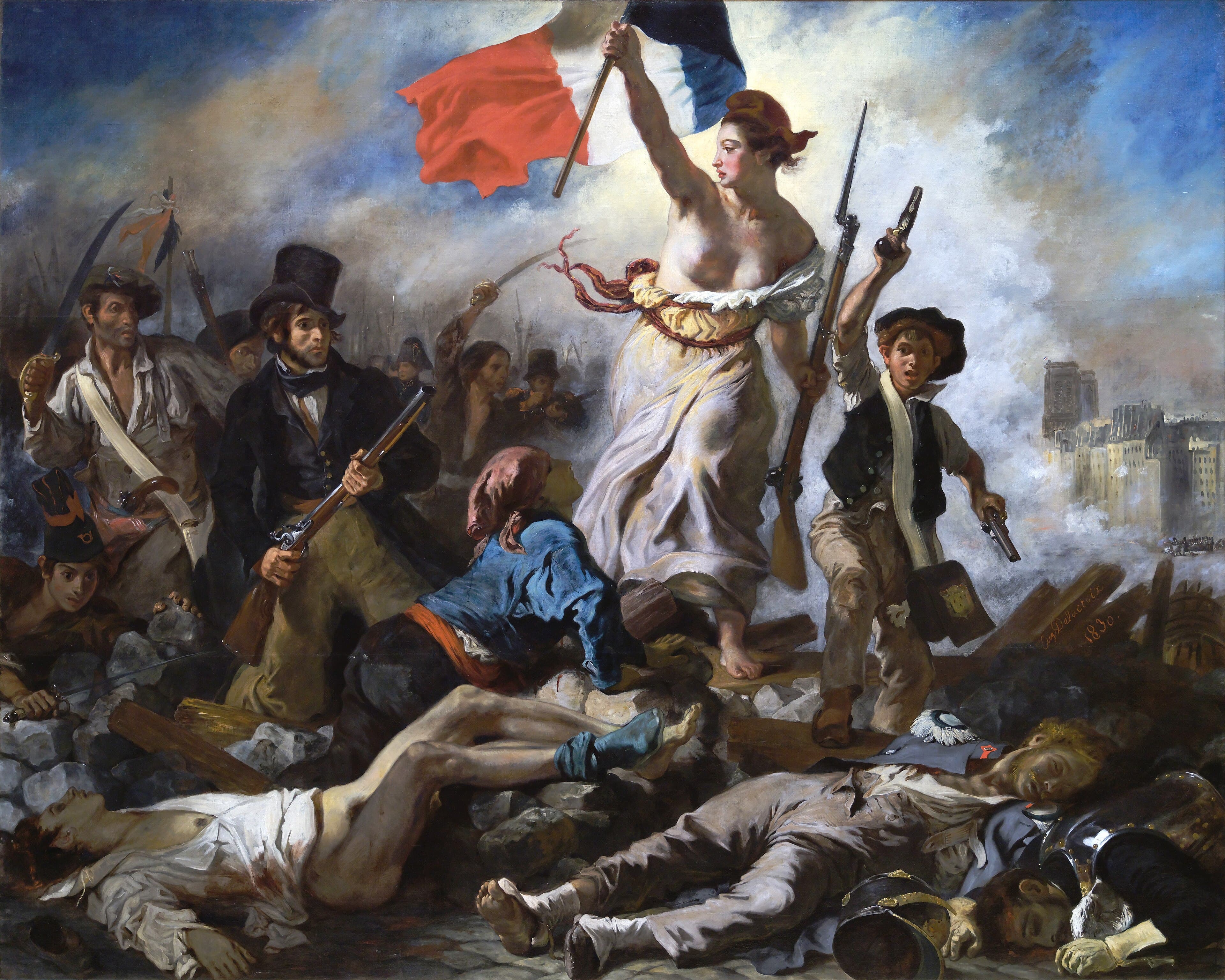
A street boy takes the barricade with a pistol in each hand. Hugo is thought to have made him into Gavroche 32 years later. Delacroix signed the timber below him and dated it 1830.
The printers went into the street first, because the king had just abolished their jobs. On the twenty-sixth of July, 1830, Charles X signed ordinances muzzling the press, dissolving the chamber and rigging the next vote, and the newspapers answered with a signed refusal to obey. Then Paris did what Paris knew how to do. Within a day the city had grown some 4,000 barricades. Paving stones, overturned carts and furniture rose in the narrow streets faster than troops could clear them. For three days, the Trois Glorieuses, the capital fought its own army. On the twenty-eighth, rebels got into Notre-Dame and ran the tricolor up the towers, where the whole city could see which way the wind stood. By the thirtieth it was over: about 800 Parisians and 200 soldiers dead, and a king packing for exile. His cousin Louis-Philippe eased onto the throne wearing a tricolor cockade, and the revolution was pickpocketed before the barricades came down. Delacroix watched the three days without fighting them. If I have not fought for my country, he wrote to his brother that October, at least I will paint for her. What he painted broke the treaty every allegory had always honored: the goddess stepped down into the reportage. His Liberty is barefoot on real rubble, with the red cap of a freed slave on her head, a musket and bayonet in her fist and dirt on her skin. She strides over corpses, one stripped to his shirt, one a soldier of the king. Around her the classes that actually fought: a workman in a beret with a saber, a bourgeois in a top hat holding a two-barreled gun, and a street boy waving two pistols. The boy would wait 32 years for Victor Hugo to give him a name. Critics were appalled exactly where the painting lives. They called her a fishwife, ignoble, unwashed. A goddess with armpit hair was not what the Salon meant by Liberty. He painted it fast, in the three months after the fighting, on a canvas close to 11 feet wide. He built it like testimony. The light is powder smoke lit by fires, the pavement is torn up stone by stone, and the dead man in the left foreground has been stripped of everything below his shirt. Delacroix had watched some of it from the streets and heard the rest across the river. For the face of Liberty he left no name; Paris supplied legends within the decade, a laundress, a fighter called Marie, none of them provable. The picture accumulates witnesses the way the barricade accumulated furniture. The new government bought the picture in 1831 for 3,000 francs, hung it, and within months took it down: a Liberty this persuasive was not safe furniture for a king made by barricades. It came out of hiding when revolution returned in 1848, went away again under the empire that followed, and only settled into the Louvre for good in 1874. Governments have alternately hung it and hidden it for two centuries, which is the most sincere review a painting has ever received. She outgrew the frame regardless. The woman on the rubble became Marianne, the face of the French Republic on stamps, statues and the 100 franc note, and the raised-flag silhouette became the stock image of every uprising since. In the smoke at the right edge, on the towers of Notre-Dame, Delacroix painted a speck of tricolor: the real flag of the twenty-eighth of July, answering hers.