Alive
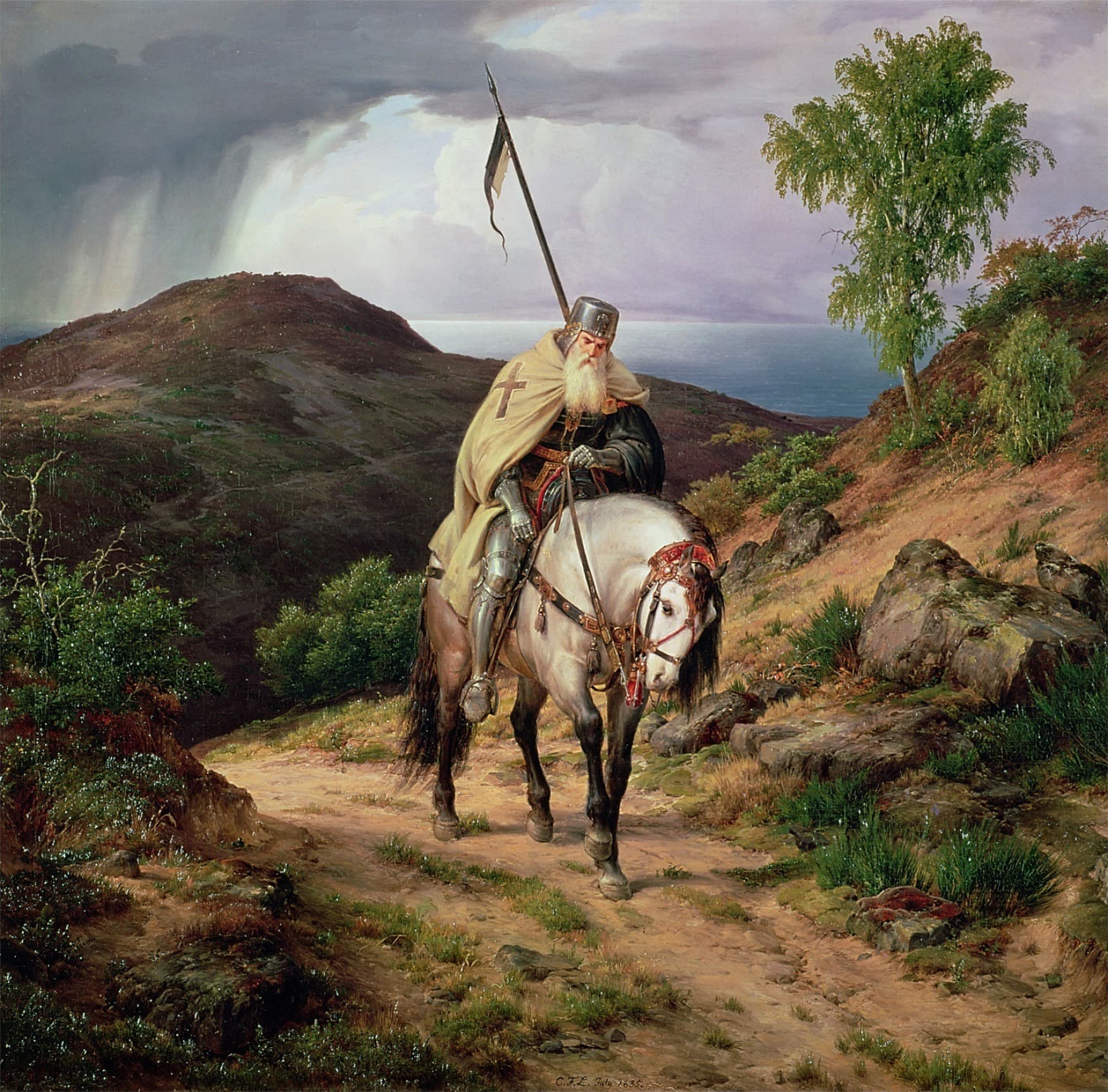
Painted in 1835. An old knight rides down a stony track on his own. The white cloak with a black cross means he belongs to the Teutonic Order, and he is coming home from a crusade. Nobody has come out to meet him. Behind him it is still raining on the far hill. Lessing was 27, and he was painting against the fashion. German artists of the 1830s liked their crusaders proud. His is a tired man on a tired horse, arriving at nothing. He took the idea from a poem by Karl Immermann, written 9 years earlier. In Germany the painting is called Der letzte Kreuzfahrer, the last crusader. Lessing signed his name in the dirt of the path: C.F.L., July 1835. He trained as a builder in Berlin before he took up painting. He was also a great-nephew of the playwright Gotthold Ephraim Lessing. The canvas is small, 66 cm by 64, and it hangs in Bonn.
look closer
The white mantle with a black cross is the habit of the Teutonic Order. Under it the knight is old, and he is looking at the ground rather than the road.