The Machine Age · 17 December 1903
Twelve Seconds
Two bicycle mechanics teach the wind to carry a man
look closer
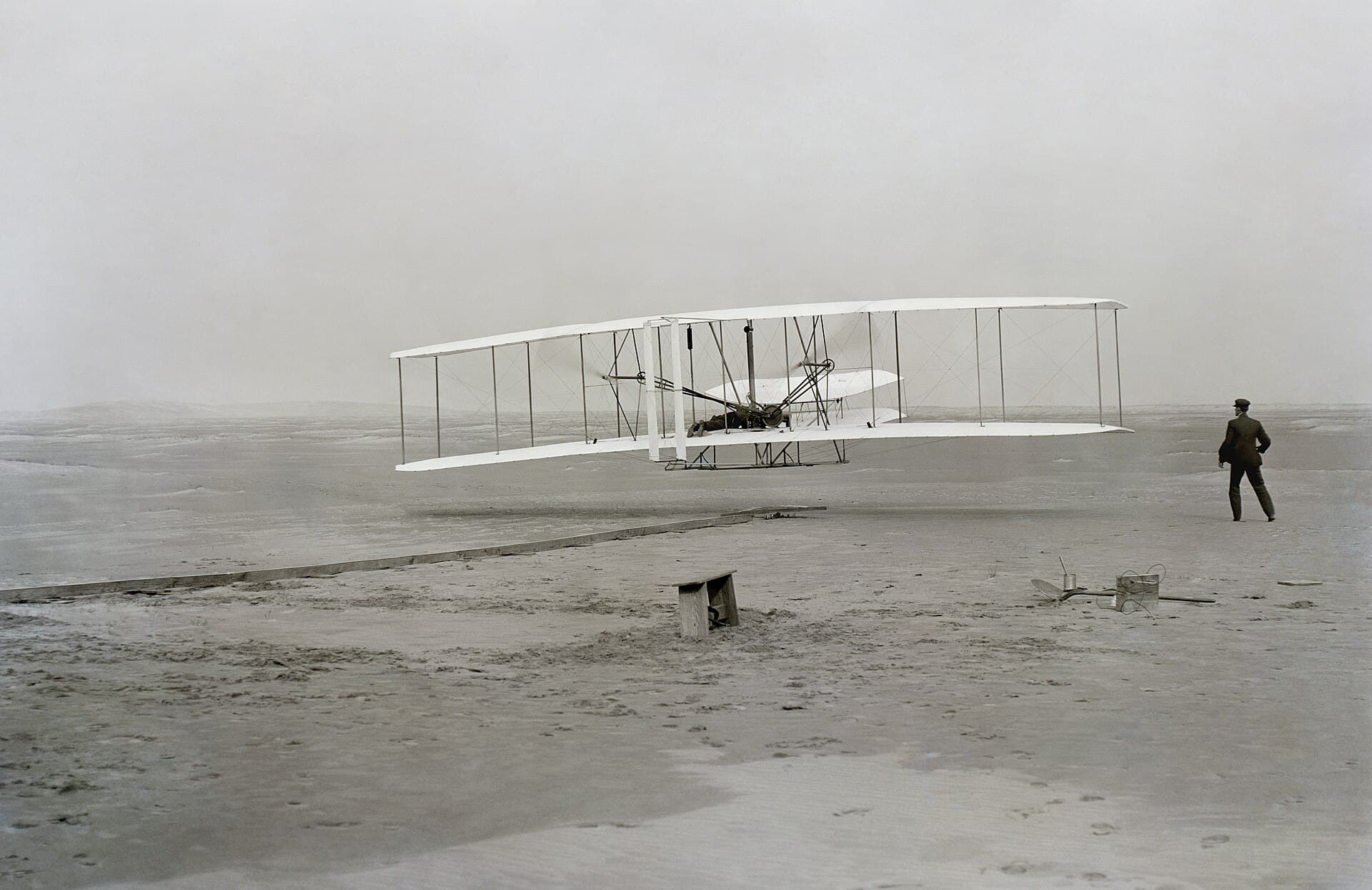
Wilbur stands in his dark suit and cap, a few strides past the point where he let go of the wingtip. Orville had set the camera himself. He left the bulb to John Daniels, a lifeguard who had never worked one.
They chose this stretch of North Carolina sand from a Weather Bureau table: steady winds, tall dunes to glide from, soft ground to fall on, and nobody watching. For three autumns the bicycle makers from Dayton have come here to fly gliders, and mostly to learn why the published numbers were wrong. After the 1901 season went badly, Wilbur said man would fly, but not within a thousand years, and not in their lifetime. Then the brothers went home and built a wind tunnel out of a 6-foot pine box and a fan. They tested 200 little wing shapes cut from bicycle-spoke steel and hacksaw blades, and corrected the lift tables the whole world had been trusting. The thousand years took two. No engine maker would build them a motor light enough. So Charlie Taylor, the machinist from their bicycle shop, cast an aluminum block and made one in 6 weeks. It gave 12 horsepower, with no throttle and no fuel pump, gravity-fed from a can on a strut. The propellers were a worse problem, because there was no theory of propellers at all; ship screws were cut by tradition and guesswork. The brothers argued it out for months until they saw the answer: a propeller is just a wing traveling in a spiral. They carved two by hand from laminated spruce, and when modern laboratories finally tested the design, it came out within a few points of today’s. The whole machine, spruce and muslin and wire, cost about a thousand dollars. The War Department had put $50,000 into Samuel Langley’s Aerodrome, which fell into the Potomac in October and again on the eighth of December. On the fourteenth of December they flipped a coin and Wilbur won, over-rotated on takeoff, and put the Flyer into the sand after three seconds. Repairs took two days. This morning the wind is blowing 27 miles an hour, too hard, really. But it is December and the brothers want to be home for Christmas, and it is Orville’s turn to lie flat on the lower wing. The beach is empty except for five witnesses, most of them lifeguards from the rescue station, and a camera on a tripod aimed at the end of a 60-foot wooden launching rail. At 10:35 the machine trundles down the rail into the headwind and rises. Twelve seconds, 120 feet, a distance shorter than the wingspan of the airliners to come. John Daniels, a lifeguard who has never operated a camera in his life, squeezes the bulb at the exact right instant and takes the most reproduced photograph in aviation. They fly four times before noon, taking turns. On the last flight Wilbur holds it steady for 59 seconds and 852 feet, and the problem of the ages is, in the plain sense, solved. Minutes later a gust catches the parked Flyer and rolls it over and over down the beach; it never flies again. The telegram home to their father asks him to inform the press, and the operator mangles it in transmission, cutting the 59 seconds to 57 and misspelling Orville’s name. Most newspapers pass; the few that print it get the details wrong or improve them into fiction. None of that reaches the beach. Four flights today. Then the wind wrecks the Flyer for good. It has already done enough.