Classical Greece · c. 447 BC
The Man on the Shield
The sculptor shows off the fresh paint, then answers for his own face on Athena’s shield
look closer
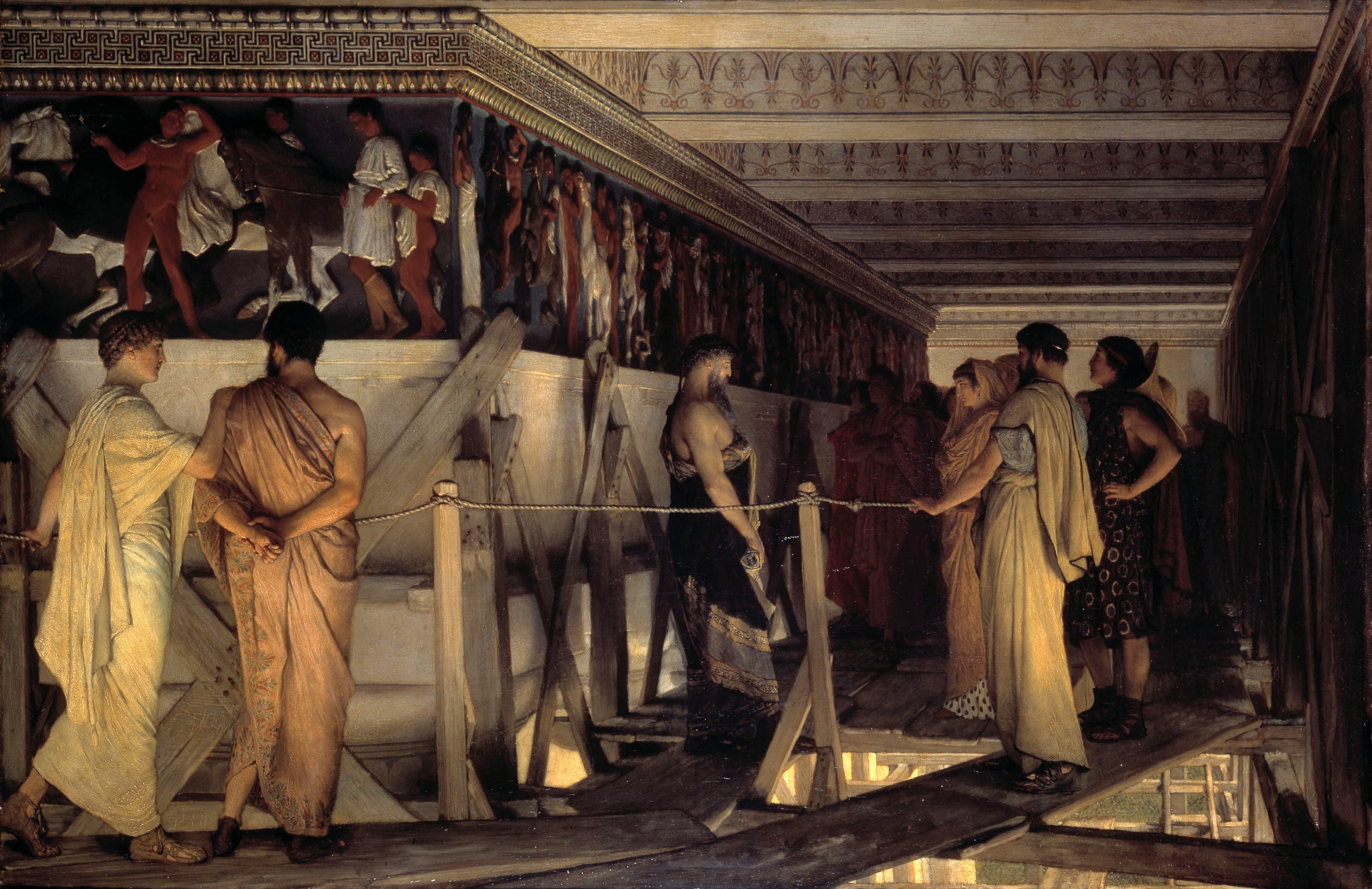
The paint on this frieze is still fresh. A red-limbed youth throws his arm up among grey horses, on a blue-black ground under a red and gold Greek key border. The finished band ran 40 feet up under the roof, too high to read.
Around 447 BC, on a plank scaffold high inside the half-built Parthenon, Phidias walked a party of friends along the new frieze, and the paint was still bright. That is the moment Alma-Tadema chose: the marble procession fresh in red and blue and gold, seen close, from the scaffolding, the way almost no Athenian ever saw it. The finished band would run 40 feet up under the roof, where the eye could barely reach. He ran the whole site. Pericles had put him in charge of the building program. The accounts were cut into stone and set up in public, year by year, talent by talent, so any citizen could read what the marble and the ivory and the gold had cost. The gold mattered most, because there was so much of it standing in one room. His statue of Athena inside was nearly 40 feet tall, wood at the core, ivory for the skin, and something over a ton of gold for the rest. Pericles had it made so the plates could be lifted off. That was deliberate. The goddess was also the reserve treasury, wearing the city’s savings where everyone could see them, and if a war ever went badly enough the gold could come down and be spent. When enemies of Pericles accused Phidias of skimming the metal, the answer was already built in: the gold was weighed, plate by plate, and it was all there. So they charged him with the other thing. On Athena’s shield he had carved a battle against the Amazons. Among the fighters he put a portrait of Pericles hurling a spear, the raised arm half hiding the face. He put in a bald old man too, heaving a rock overhead with both hands, and everyone knew that was Phidias looking at Phidias. Plutarch says it could not be missed from any angle. Setting your own face on the divine shield was impiety, and impiety was a charge that could kill. What happened next the sources cannot agree on. In one, he died in an Athenian prison. In Plutarch’s version he went into exile at Elis, where they hired him to make an even bigger god, the seated Zeus at Olympia that later counted among the seven wonders. At Olympia in the 1950s archaeologists dug up a workshop the right size for that Zeus, and in it a plain black drinking cup with words scratched on the underside: I belong to Pheidias. The frieze he is showing his friends here, still wet in the picture, mostly survives too, though scattered. Alma-Tadema painted this in 1868, when the greater part of it had been in London for half a century, prised off the ruin by Lord Elgin’s men and sold to the nation. He gave the wall its lost color back on a canvas just over a meter wide, and it hangs now in Birmingham.