The Age of Sail · 5 September 1838
The Last Tow
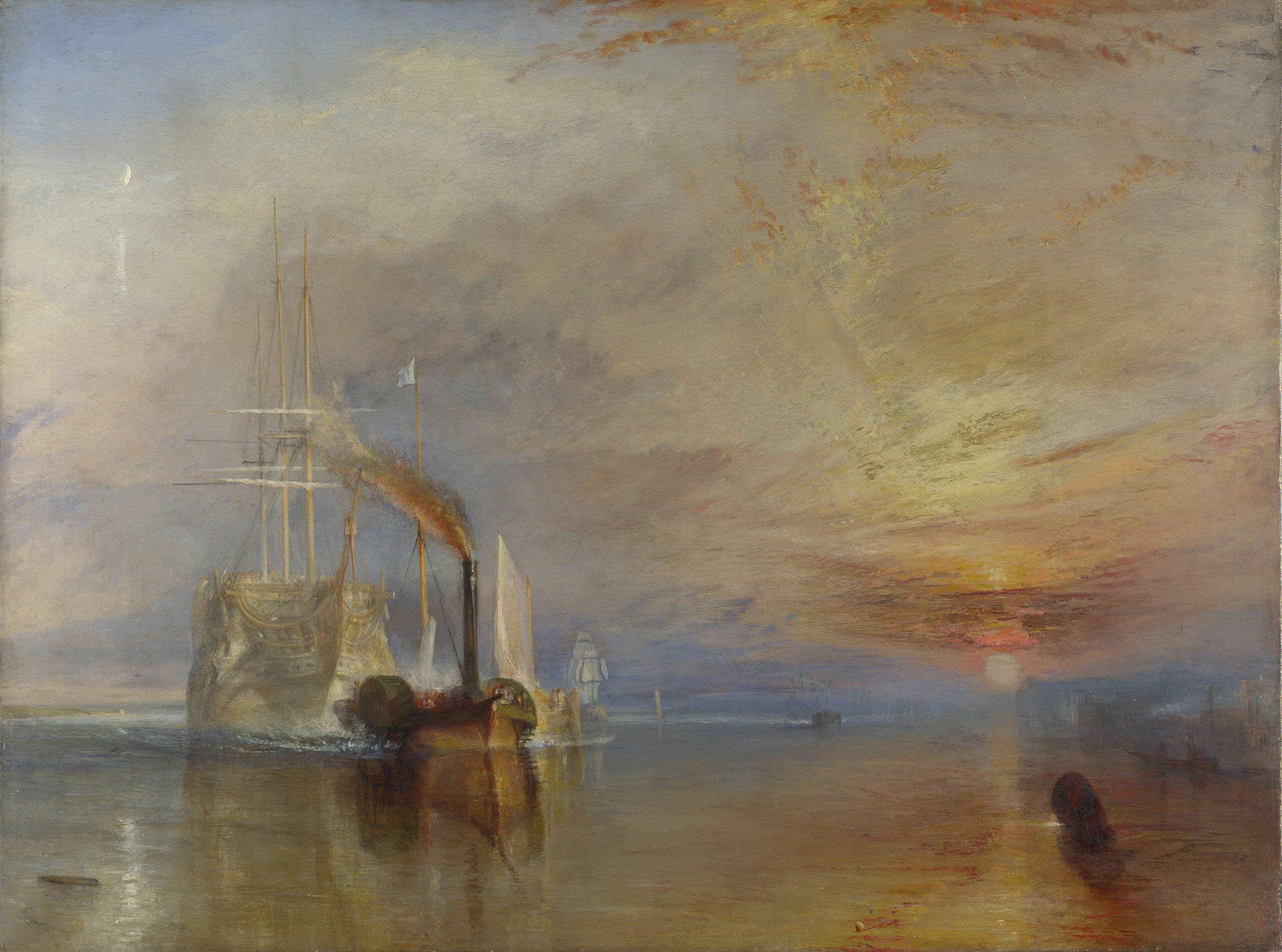
A smoking kettle hauls Trafalgar to the scrapyard at sunset
look closer
The tug is black and low, with fire showing at the top of its funnel. Turner put the machine in front of the ship it is dragging away to be broken up.
The Navy sold her for the value of her materials: 5,530 pounds, payable by Mr Beatson, ship-breaker, of Rotherhithe. In the first week of September 1838 the Temeraire, 98 guns, veteran of Trafalgar, left Sheerness at the end of a rope. Two steam tugs hauled her up the Thames to the breaker's yard over two days. She had no masts; they had been taken out long before, with the guns and everything else the service could reuse. What went upriver was a hulk, a huge emptied barrel of oak that 33 years earlier had been the most famous ship in England after the Victory herself. At Trafalgar she had been next astern of Nelson's flagship. When the Victory was being shot to pieces, the Temeraire ranged up and took the enemy's fire onto herself. She ended the afternoon lashed between two captured French ships, one on each side. The newspapers made her the Fighting Temeraire and the name stuck for three decades. She went through blockade duty, prison-ship duty and receiving-ship duty, the long unglamorous old age of wooden warships, until the Admiralty's arithmetic caught up with her. Old oak had a market. Ships of the line went into house beams, furniture and church pews, and the Temeraire went the way of all of them. Turner turned the accounting into a funeral. Whether he actually watched the tow is doubtful, whatever he let people believe. The picture is built from licenses. He put the masts back and crossed the yards, and dressed the hull in ghost-white and gold. He moved the sunset to where the drama needed it and set a thin moon rising above the ship. The one thing he painted with brute honesty is the tug: squat, black, iron, its funnel coughing fire ahead of the tall ghost behind it. He did not caricature it. It is simply the future, small and hot and effective, and it is in front. The yard did its work and the ship dispersed into England. Beatson broke her up over two years, and her oak went where old warship oak went, into beams and furniture and souvenirs. A church a short walk from the yard still keeps an altar table and two chairs made from her timbers, Trafalgar oak doing parish duty. The painting's fortunes ran the other way. At the Academy it was surrounded from the first morning. Thackeray called it as grand a painting as ever figured on the walls of any academy. The little demon of a steamer, he told his readers, belonged to the poem as much as the ghost behind it. Turner was 64. He never painted a subject the public loved more, and he knew it, which is why no sum on earth could pry it loose. In 1839 he hung it with a borrowed line of verse: the flag that braved the battle and the breeze owns her no more. Turner called it his darling, refused every offer to buy, and left it to the nation with the rest of his hoard when he died. The nation eventually put the painting on the 20-pound note, the painter beside his ship. In the picture's right corner, easy to miss, a dark buoy floats where the channel bends toward Rotherhithe, marking the way to the yard. The moon is already up.