Classical Greece · August, 480 BC
The Hot Gates
Sparta sends 300 men to hold a doorway the width of a wagon road
look closer
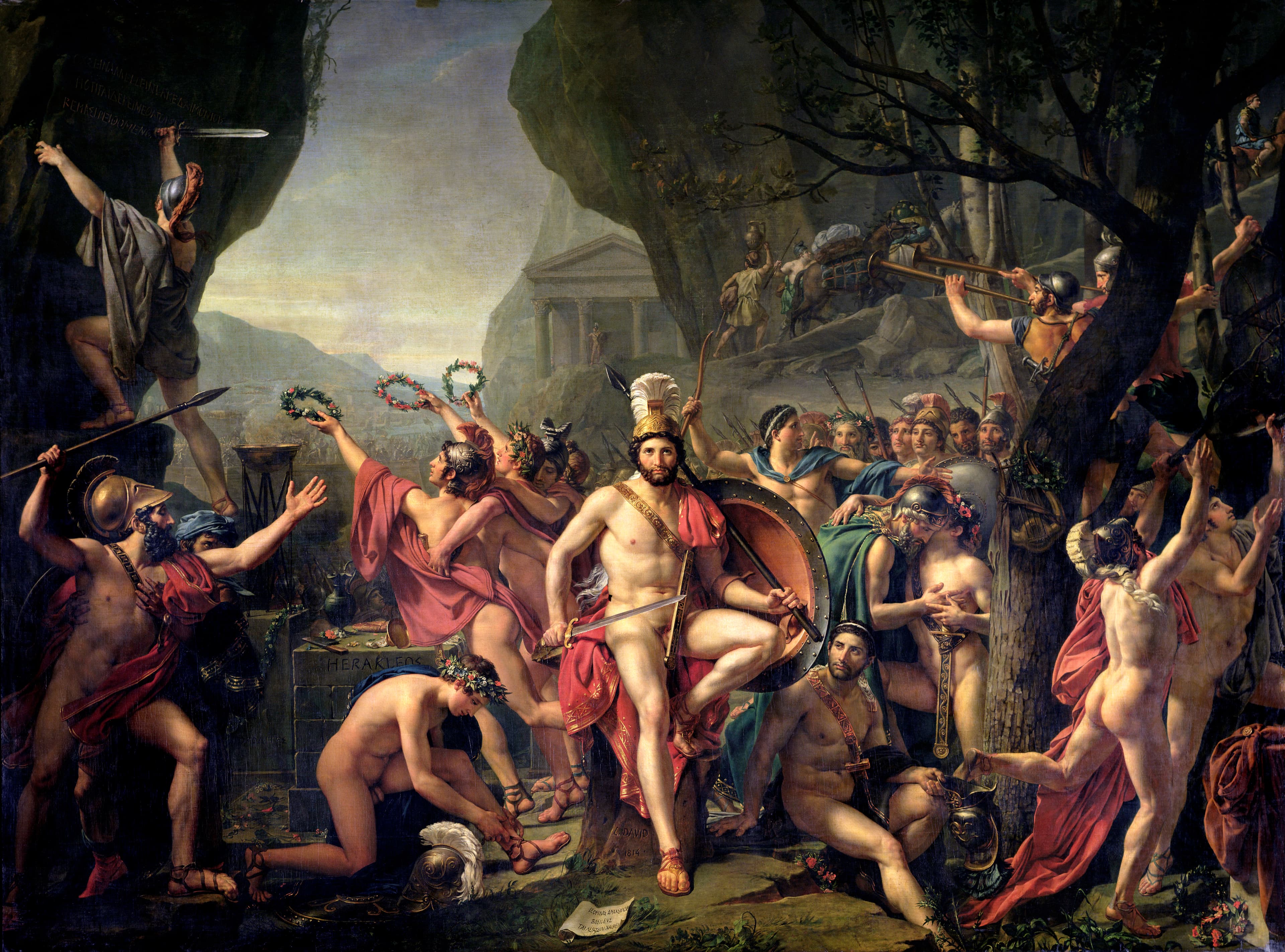
Leonidas sits at the center of the noise with his sword across one knee and looks at nothing. David started this canvas in 1799, put it away, and did not finish it until 1814.
The pass is called Thermopylae, the Hot Gates, for the sulfur springs that steam beside the road. Here the mountains lean so close to the sea that the whole invading world must walk through a corridor 50 feet wide. Xerxes has spent four years assembling that world. His engineers bridged the Hellespont with boats lashed gunwale to gunwale, and when a storm broke the first bridge he had the sea itself given 300 lashes, then built another. His army was counted at the crossing by penning 10,000 men at a time inside a fence and filling it over and over. The Greeks say a million came; even sober men lost count; modern guesses shrink it to the low hundreds of thousands and it hardly matters, because against it stand some 7,000 Greeks. At their core are 300 Spartans under a king named Leonidas. The oracle had told him that Sparta would lose a king or lose itself, and he chose his 300 only from men with living sons. For two days the corridor does what he hoped. Numbers mean nothing where only a few hundred can fight at once, and the long Greek spear outreaches everything walking toward it. The Medes are driven onto the Greek line with whips and pile up against the narrows; the Immortals, the king’s own 10,000, come in the afternoon and do no better. Told that the Persian arrows fly thick enough to hide the sun, a Spartan named Dieneces answers: good, then we fight in the shade. Xerxes, watching from a silver-footed throne on the hillside, three times leaps to his feet in rage. The mountain, not the army, decides the matter. A local man named Ephialtes knows the goat path over the ridge and sells it, and by night the Immortals are climbing through the oak woods above the pass. Word comes at dawn from lookouts running downhill. Leonidas sends the allied contingents away while the road south is still open, and keeps his Spartans, for whom retreat is not in the instructions. All 700 hoplites of the small town of Thespiae refuse to leave and stay beside them by choice, along with 400 Thebans. The Spartans eat breakfast, and comb their long hair, the way Spartans do before dying, and walk out to meet the morning. They fight in the widest part of the pass this time, to reach more of the enemy. Spears splinter; they fight with swords, then with hands and teeth, the historian says, and he does not seem to be exaggerating. Leonidas falls early, and four times the Greeks pull his body back out of the crush. The survivors withdraw to a small hill and are finished with arrows at leisure. Xerxes has the king’s head set on a stake, which Persians, who honor brave enemies, considered a disgrace to Xerxes. The road to Athens lies open; the city is evacuated and burned; and a month later the fleet at Salamis takes the whole invasion apart in an afternoon. At the pass the Greeks later cut an epitaph for the 300: go, tell the Spartans, stranger passing by, that here, obedient to their word, we lie. Thespiae, which lost every armored man it had, got no verse anyone remembers. The spring still steams beside the road.