Ancient Egypt · c. 2900 BC
The God with the Mark
Egypt keeps one living god in a stall at Memphis and reads its future in its moods
look closer
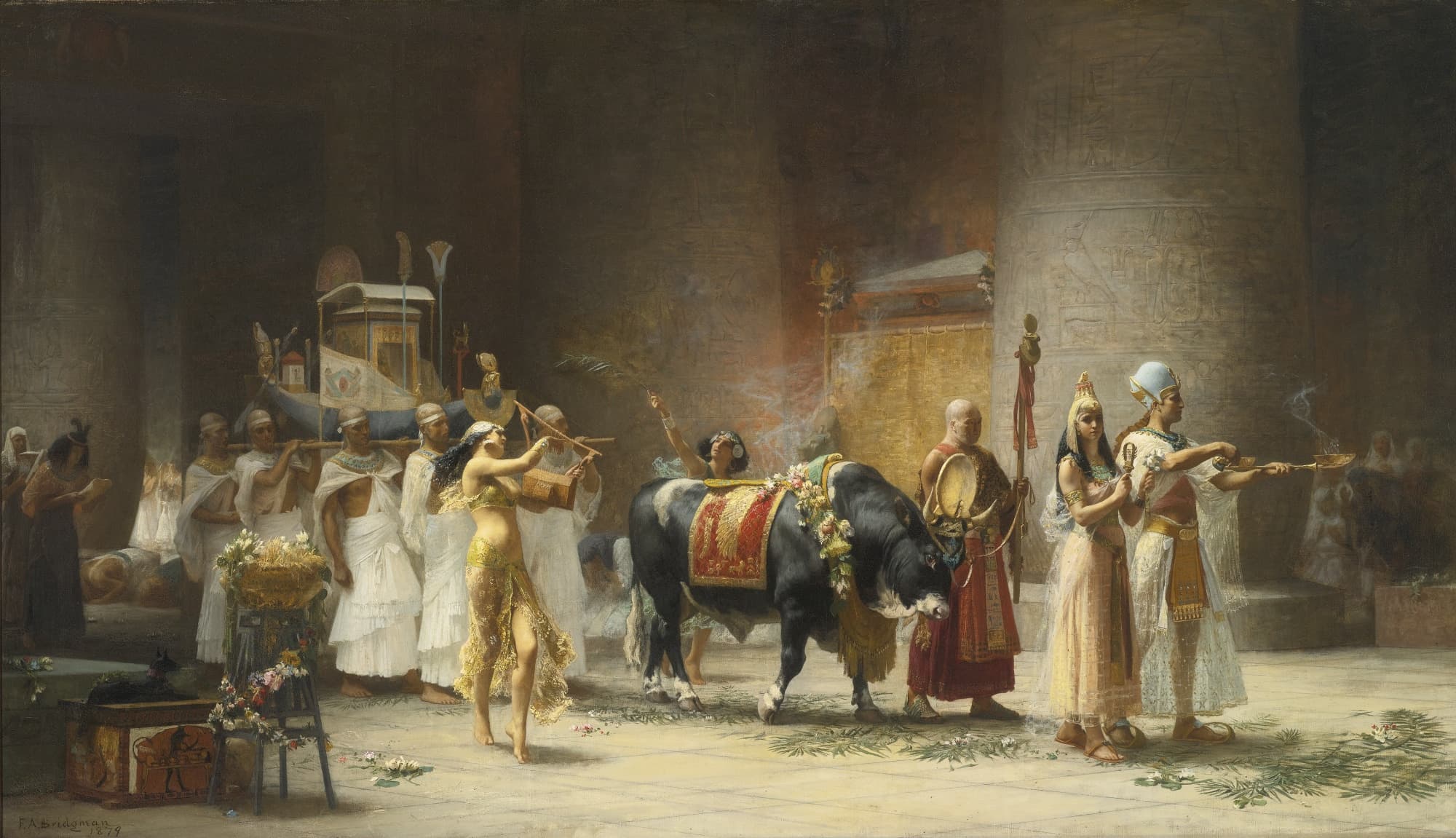
The bull walks under a red and gold cloth with flowers heaped over its shoulders. White breaks through the black hide at the flank and the muzzle. Priests looking for the next Apis wanted exactly that pattern of white on black, the one Herodotus wrote down.
The god is a bull, and there is only ever one. When the old Apis died at Memphis, priests went out across Egypt to find the calf its soul had entered, and they knew the right animal by its skin. Herodotus lists the marks: black, with a white triangle on the forehead, the shape of an eagle spread across its back, double hairs in its tail, and a scarab under its tongue. A calf born with those signs was the living body of Ptah, the craftsman god who made the world. It would spend its life in a stall beside his temple, fed, painted, and consulted. Which of two offered mangers it chose to eat from was an answer. Which way it turned was an answer. Germanicus, the Roman prince, fed it by hand in AD 19 and it refused him, and he was dead within the year. The bull was born to die on a schedule. By the Roman period a bull that reached 25 years was drowned in a sacred spring, because a god could not be allowed to die of anything so ordinary as old age. Then the country went into a mourning it took seriously: 60 days of it, heads shaved, no meat, the way you would grieve a person. It lasted until the search parties came back with word that Apis had been found again in a new calf, and the grief turned to festival in a single day. The dead bull was not buried like an animal. It was embalmed at the temple, wrapped, and fitted with gilded masks and jewelry and amulets. Then it was carried in procession to a burial ground in the desert at Saqqara, where the god became one with Osiris and took the name Osiris-Apis. Bridgman painted that procession in 1879. He had sailed the Nile a few years earlier filling sketchbooks, and he built the canvas out of what he saw. The black bull walks under a saddle-cloth of red and gold, hung with flowers, led between the columns. A dancer plays a lyre, and priests swing incense burners and beat the tambourine. The Alabama-born painter gave the god its flowers and its smoke, and set the whole rite moving toward the door. Where it was moving became one of the great finds of the century. In 1850 a young Frenchman named Auguste Mariette came to Egypt to buy Coptic manuscripts for the Louvre, got nowhere with the monks, and went walking at Saqqara instead. He noticed the head of a sphinx breaking the sand, then another, and recognized the buried avenue the geographer Strabo had described more than 18 centuries before. He hired 30 men, dug without a permit, and in 1851 broke into the vaults. It was a long underground gallery lined with chambers, each holding a granite sarcophagus the size of a small room. Some weighed 70 tons, cut and lowered and slid into place for one bull each. Robbers had emptied nearly all of them in antiquity. One sealed sarcophagus held the fingerprints, still in the dust on the lid, of the last men to close it.