Ancient Egypt · c. 1350 BC
Gods to Order
In an Egyptian workshop the gods themselves are turned out by hand, a shelf at a time
look closer
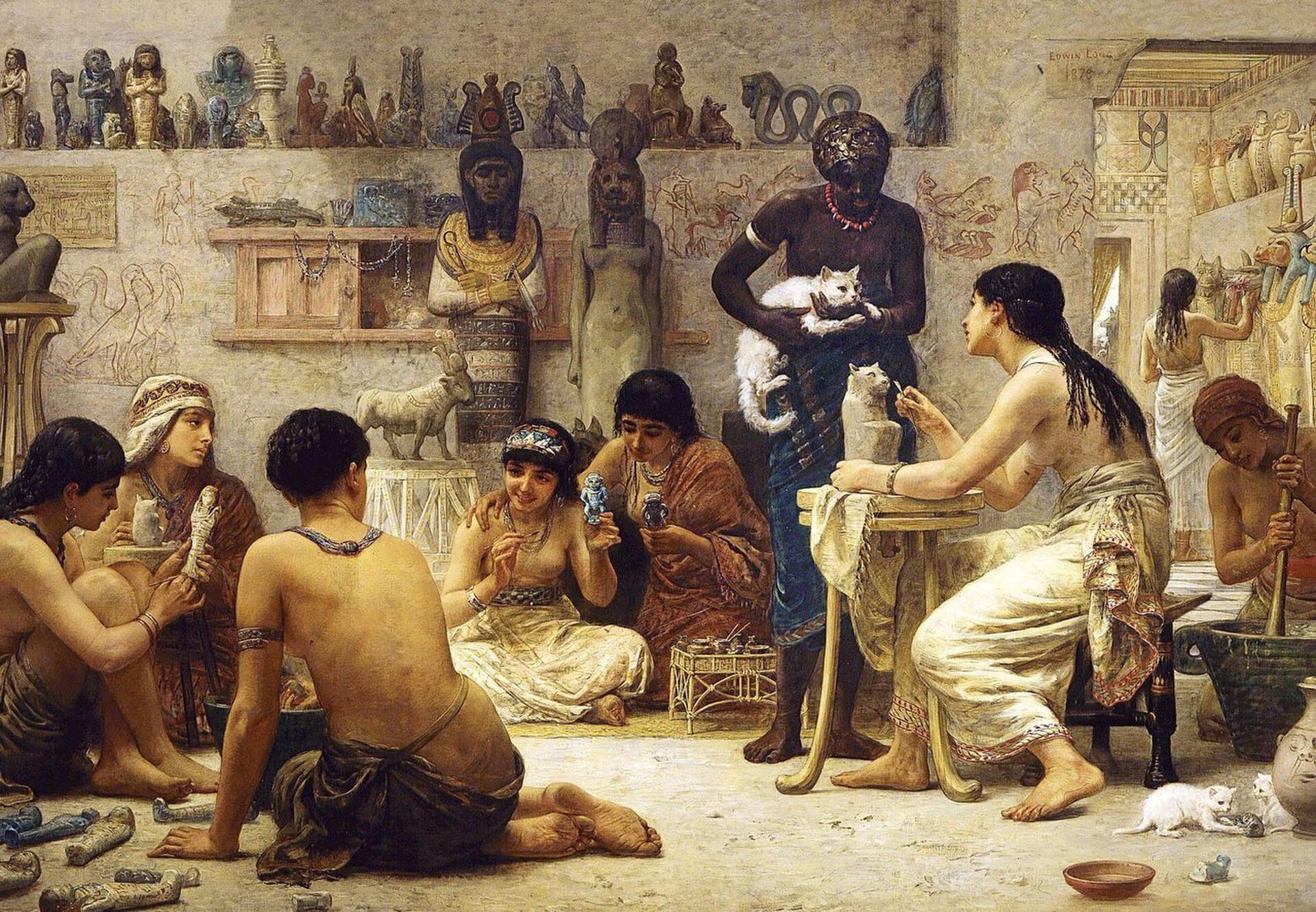
A green glazed crocodile lies on the ledge, and strings of beads hang off the shelf. Behind them a dark bust in a plumed crown stands next to Sekhmet, the lion-headed goddess under her sun disk. None of it was a god yet. A statue was a house the god might be coaxed into, and only a priest could do the coaxing.
In a crowded workshop somewhere in Egypt, people who will go home tired are making the gods by hand. Along the back shelf the finished stock stands ready for sale: rows of little blue faience figures, seated deities, a coiled serpent, a green crocodile laid out on the ledge below, waiting for buyers. On the floor and at the tables the makers work. A woman turns a small idol in the light and studies it. A boy leans both hands on a pestle and works it in a heavy stone mortar. Others carve, paint, and polish, and the whole trade of Egyptian religion, the amulets pilgrims bought by the thousand and the statuettes they left at shrines, ran through rooms like this. The divine had a supply chain. Egypt saw no contradiction in that. A statue was not the god; it was a house the god could be persuaded to enter, and the entering was done by ritual, not by the sculptor. A finished figure went through the same Opening of the Mouth ceremony performed on a mummy, touched with an adze so it could breathe and see, and only then did it hold anything. Until the priest came, what left the workshop was painted clay and stone. The men who made the gods knew exactly what they were selling, which was the raw material of belief, priced by size. Edwin Long painted this in 1878 and called it The Gods and Their Makers. He had toured Egypt and Syria in 1874 and come back soaked in the look of the place. He built the workshop from real objects: the faience colors, the animal-headed forms, the cluttered shelves of a coppersmith’s or modeler’s shop. It is a big canvas, well over 7 feet wide, and it was a hit in London. A public raised on the Second Commandment could enjoy the faint scandal of watching idols knocked out like crockery. Long put a joke in the corner that his audience would have caught. Egyptians kept cats, and cats were sacred to the goddess Bastet. At the right-hand table a woman is finishing a stone cat with a fine brush, and directly above her hands a man stands holding a live white cat against his chest. The real thing and the thing for sale, one warm and one still wet with paint, and the makers too busy to notice the pairing.